
 Google
Câu hỏi: Cho số phức $z$ thỏa mãn $\dfrac{1-i}{z}$ là số thuần ảo và $\left| z-2-i \right|=m,$ với $m\in \mathbb{R}.$ Có bao nhiêu giá trị thực của $m$ để có đúng một số phức $z$ thỏa mãn bài toán?
A. $1$.
B. $2$.
C. $3$.
D. $4.$
Cách 1: Phương pháp hình học
$\bullet $ Gọi $z=a+bi \left( a,b\in \mathbb{R}; z\ne 0 \right)\Rightarrow $ $\dfrac{1-i}{z}=\dfrac{1-i}{a+bi}=\dfrac{\left( 1-i \right)\left( a-bi \right)}{\left( a+bi \right)\left( a-bi \right)}=\dfrac{\left( a-b \right)-\left( a+b \right)i}{{{a}^{2}}+{{b}^{2}}}=\dfrac{a-b}{{{a}^{2}}+{{b}^{2}}}-\dfrac{\left( a+b \right)}{{{a}^{2}}+{{b}^{2}}}i$
$\bullet $ $\dfrac{1-i}{z}$ là số thuần ảo $\Leftrightarrow \dfrac{a-b}{{{a}^{2}}+{{b}^{2}}}=0\Leftrightarrow a=b.$ Khi đó $M(z)$ thuộc đường thẳng $d:y=x$
$\bullet $ Ta có $\left| z-2-i \right|=m$ với $m>0$ là đường tròn $(C)$ tâm $I(2;1),R=m$ (với $m=0$ thì không thỏa đề)
Khi đó, yêu cầu bài toán có 2 trường hợp: (xem hình vẽ)
TH1: $d$ tiếp xúc với $(C)$ tại 1 điểm khác gốc tọa độ $\Leftrightarrow $ $\left\{ \begin{aligned}
& d\left( I;d \right)=m \\
& IO\ne m \\
\end{aligned} \right.\Leftrightarrow \left\{ \begin{aligned}
& m=\dfrac{1}{\sqrt{2}} \\
& \sqrt{5}\ne m \\
\end{aligned} \right.$.
TH2: $d$ cắt $(C)$ tại 2 điểm phân biệt, trong đó có 1 điểm là gốc tọa độ $\Leftrightarrow $ $\left\{ \begin{aligned}
& d\left( I;d \right)<m \\
& IO=m \\
\end{aligned} \right.\Leftrightarrow \left\{ \begin{aligned}
& m>\dfrac{1}{\sqrt{2}} \\
& \sqrt{5}=m \\
\end{aligned} \right.$.
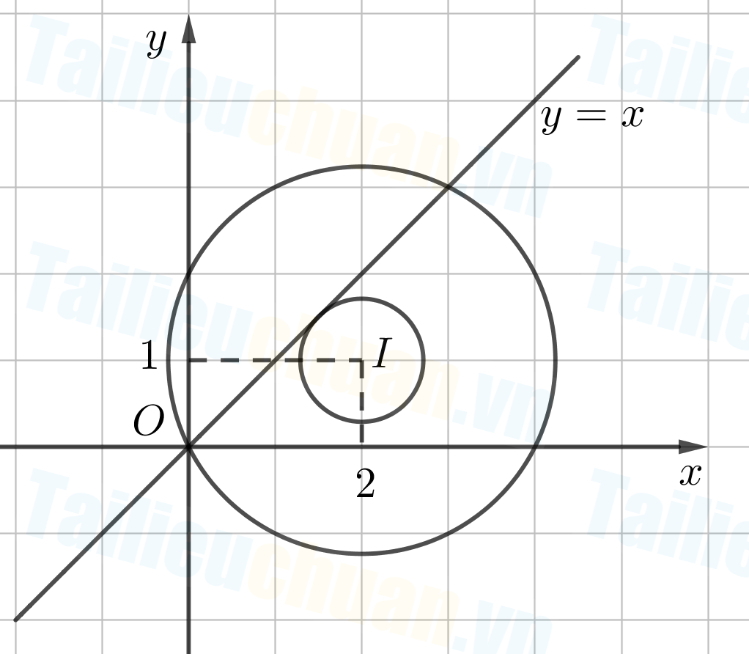 Vậy có $2$ giá trị của $m$ thỏa mãn bài toán là $m=\dfrac{\sqrt{2}}{2}$ và $m=\sqrt{5}.$
Cách 2: Phương pháp đại số
$\bullet $ Gọi $z=a+bi \left( a,b\in \mathbb{R}; {{a}^{2}}+{{b}^{2}}>0 \right)\Rightarrow $ $\dfrac{1-i}{z}=\dfrac{1-i}{a+bi}=\dfrac{\left( 1-i \right)\left( a-bi \right)}{\left( a+bi \right)\left( a-bi \right)}=\dfrac{\left( a-b \right)-\left( a+b \right)i}{{{a}^{2}}+{{b}^{2}}}=\dfrac{a-b}{{{a}^{2}}+{{b}^{2}}}-\dfrac{\left( a+b \right)}{{{a}^{2}}+{{b}^{2}}}i$
$\bullet $ $\dfrac{1-i}{z}$ là số thuần ảo $\Leftrightarrow \dfrac{a-b}{{{a}^{2}}+{{b}^{2}}}=0\Leftrightarrow a=b.$ Khi đó $z=a+ai$, với $a\ne 0$.
$\bullet $ Ta có $\left| z-2-i \right|=m\Leftrightarrow \left| a+ai-2-i \right|=m\Leftrightarrow \sqrt{{{(a-2)}^{2}}+{{(a-1)}^{2}}}=m\Leftrightarrow \left\{ \begin{aligned}
& m\ge 0 \\
& 2{{a}^{2}}-6a+5-{{m}^{2}}=0, (*) \\
\end{aligned} \right..$
$\bullet $ Có đúng một số phức $z$ thỏa mãn bài toán $\Leftrightarrow $ Phương trình (*) có nghiệm duy nhất $a\ne 0$.
Trường hợp 1: (*) có nghiệm kép khác $0\Leftrightarrow $ $\left\{ \begin{aligned}
& {\Delta }'=9-2\left( 5-{{m}^{2}} \right)=0 \\
& -\dfrac{-6}{2.2}\ne 0 \\
\end{aligned} \right.\Leftrightarrow 2{{m}^{2}}-1=0\Leftrightarrow \left[ \begin{aligned}
& m=\dfrac{\sqrt{2}}{2} (n) \\
& m=-\dfrac{\sqrt{2}}{2} (l) \\
\end{aligned} \right.$
Trường hợp 2: (*) có một nghiệm ${{a}_{1}}=0$ và một nghiệm ${{a}_{2}}\ne 0$. Thay ${{a}_{1}}=0$ vào phương trình ta có:
$5-{{m}^{2}}=0$ $\Leftrightarrow \left[ \begin{aligned}
& m=\sqrt{5} \\
& m=-\sqrt{5} (l) \\
\end{aligned} \right. $. Ta thấy $ m=\sqrt{5} $ thỏa mãn vì khi đó ta có $ {{a}_{1}}=0 $; $ {{a}_{2}}=3\ne 0$.
Vậy có $2$ giá trị của $m$ thỏa mãn bài toán là $m=\dfrac{\sqrt{2}}{2}$ và $m=\sqrt{5}.$.
A. $1$.
B. $2$.
C. $3$.
D. $4.$
Cách 1: Phương pháp hình học
$\bullet $ Gọi $z=a+bi \left( a,b\in \mathbb{R}; z\ne 0 \right)\Rightarrow $ $\dfrac{1-i}{z}=\dfrac{1-i}{a+bi}=\dfrac{\left( 1-i \right)\left( a-bi \right)}{\left( a+bi \right)\left( a-bi \right)}=\dfrac{\left( a-b \right)-\left( a+b \right)i}{{{a}^{2}}+{{b}^{2}}}=\dfrac{a-b}{{{a}^{2}}+{{b}^{2}}}-\dfrac{\left( a+b \right)}{{{a}^{2}}+{{b}^{2}}}i$
$\bullet $ $\dfrac{1-i}{z}$ là số thuần ảo $\Leftrightarrow \dfrac{a-b}{{{a}^{2}}+{{b}^{2}}}=0\Leftrightarrow a=b.$ Khi đó $M(z)$ thuộc đường thẳng $d:y=x$
$\bullet $ Ta có $\left| z-2-i \right|=m$ với $m>0$ là đường tròn $(C)$ tâm $I(2;1),R=m$ (với $m=0$ thì không thỏa đề)
Khi đó, yêu cầu bài toán có 2 trường hợp: (xem hình vẽ)
TH1: $d$ tiếp xúc với $(C)$ tại 1 điểm khác gốc tọa độ $\Leftrightarrow $ $\left\{ \begin{aligned}
& d\left( I;d \right)=m \\
& IO\ne m \\
\end{aligned} \right.\Leftrightarrow \left\{ \begin{aligned}
& m=\dfrac{1}{\sqrt{2}} \\
& \sqrt{5}\ne m \\
\end{aligned} \right.$.
TH2: $d$ cắt $(C)$ tại 2 điểm phân biệt, trong đó có 1 điểm là gốc tọa độ $\Leftrightarrow $ $\left\{ \begin{aligned}
& d\left( I;d \right)<m \\
& IO=m \\
\end{aligned} \right.\Leftrightarrow \left\{ \begin{aligned}
& m>\dfrac{1}{\sqrt{2}} \\
& \sqrt{5}=m \\
\end{aligned} \right.$.
Cách 2: Phương pháp đại số
$\bullet $ Gọi $z=a+bi \left( a,b\in \mathbb{R}; {{a}^{2}}+{{b}^{2}}>0 \right)\Rightarrow $ $\dfrac{1-i}{z}=\dfrac{1-i}{a+bi}=\dfrac{\left( 1-i \right)\left( a-bi \right)}{\left( a+bi \right)\left( a-bi \right)}=\dfrac{\left( a-b \right)-\left( a+b \right)i}{{{a}^{2}}+{{b}^{2}}}=\dfrac{a-b}{{{a}^{2}}+{{b}^{2}}}-\dfrac{\left( a+b \right)}{{{a}^{2}}+{{b}^{2}}}i$
$\bullet $ $\dfrac{1-i}{z}$ là số thuần ảo $\Leftrightarrow \dfrac{a-b}{{{a}^{2}}+{{b}^{2}}}=0\Leftrightarrow a=b.$ Khi đó $z=a+ai$, với $a\ne 0$.
$\bullet $ Ta có $\left| z-2-i \right|=m\Leftrightarrow \left| a+ai-2-i \right|=m\Leftrightarrow \sqrt{{{(a-2)}^{2}}+{{(a-1)}^{2}}}=m\Leftrightarrow \left\{ \begin{aligned}
& m\ge 0 \\
& 2{{a}^{2}}-6a+5-{{m}^{2}}=0, (*) \\
\end{aligned} \right..$
$\bullet $ Có đúng một số phức $z$ thỏa mãn bài toán $\Leftrightarrow $ Phương trình (*) có nghiệm duy nhất $a\ne 0$.
Trường hợp 1: (*) có nghiệm kép khác $0\Leftrightarrow $ $\left\{ \begin{aligned}
& {\Delta }'=9-2\left( 5-{{m}^{2}} \right)=0 \\
& -\dfrac{-6}{2.2}\ne 0 \\
\end{aligned} \right.\Leftrightarrow 2{{m}^{2}}-1=0\Leftrightarrow \left[ \begin{aligned}
& m=\dfrac{\sqrt{2}}{2} (n) \\
& m=-\dfrac{\sqrt{2}}{2} (l) \\
\end{aligned} \right.$
Trường hợp 2: (*) có một nghiệm ${{a}_{1}}=0$ và một nghiệm ${{a}_{2}}\ne 0$. Thay ${{a}_{1}}=0$ vào phương trình ta có:
$5-{{m}^{2}}=0$ $\Leftrightarrow \left[ \begin{aligned}
& m=\sqrt{5} \\
& m=-\sqrt{5} (l) \\
\end{aligned} \right. $. Ta thấy $ m=\sqrt{5} $ thỏa mãn vì khi đó ta có $ {{a}_{1}}=0 $; $ {{a}_{2}}=3\ne 0$.
Vậy có $2$ giá trị của $m$ thỏa mãn bài toán là $m=\dfrac{\sqrt{2}}{2}$ và $m=\sqrt{5}.$.
Đáp án B.