
 Google
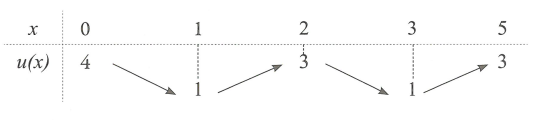
Câu hỏi: Cho hàm số $u(x)$ liên tục trên đoạn $\left[ 0;5 \right]$ và có bảng biến thiên như hình vẽ bên dưới. Có bao nhiêu giá trị nguyên m để phương trình $\sqrt{3\text{x}}+\sqrt{10-2\text{x}}=m.u(x)$ có nghiệm trên đoạn $\left[ 0;5 \right]$ ?
 A. 6
A. 6
B. 4
C. 5
D. 3
B. 4
C. 5
D. 3
Theo bảng biến thiên ta có trên $\left[ 0;5 \right]$ thì $1\le u(x)\le 4$ (1).
Ta có $\sqrt{3\text{x}}+\sqrt{10-2\text{x}}=m.u(x)\Leftrightarrow \dfrac{\sqrt{3\text{x}}+\sqrt{10-2\text{x}}}{u(x)}=m$
Xét hàm số $f(x)=\sqrt{3\text{x}}+\sqrt{10-2\text{x}}$ trên $\left[ 0;5 \right]$
Ta có ${f}'(x)=\dfrac{\sqrt{3}}{2\sqrt{x}}-\dfrac{2}{2\sqrt{10-2\text{x}}};{f}'(x)=0\Leftrightarrow \sqrt{3}\sqrt{10-2\text{x}}=2\sqrt{x}\Leftrightarrow 3(10-2\text{x})=4\text{x}\Leftrightarrow x=3$.
Bảng biến thiên:
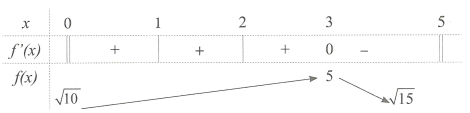 Do đó ta có trên $\left[ 0;5 \right]$ thì $\sqrt{10}\le f(x)\le 5$ (2). Từ (1) và (2) ta có $\left\{ \begin{aligned}
& \max f(x)=f(3)=5 \\
& \min u(x)=u(3)=1 \\
\end{aligned} \right.$ và
$\left\{ \begin{aligned}
& \min f(x)=f(0)=\sqrt{10} \\
& \max u(x)=u(0)=4 \\
\end{aligned} \right. $. Do đó $ \dfrac{\sqrt{10}}{4}\le \dfrac{f(x)}{u(x)}\le 5 $ với mọi $ x\in \left[ 0;5 \right]$.
Để phương trình $\sqrt{3\text{x}}+\sqrt{10-2x}=m.u(x)$ có nghiệm trên đoạn $\left[ 0;5 \right]\Leftrightarrow $ phương trình
$\dfrac{\sqrt{3x}+\sqrt{10-2\text{x}}}{u(x)}=m$ có nghiệm trên đoạn $\left[ 0;5 \right]\Leftrightarrow \dfrac{\sqrt{10}}{4}\le m\le 5$.
Vì $m\in \mathbb{Z}$ nên $m\in \left\{ 1;2;3;4;5 \right\}$.
Ta có $\sqrt{3\text{x}}+\sqrt{10-2\text{x}}=m.u(x)\Leftrightarrow \dfrac{\sqrt{3\text{x}}+\sqrt{10-2\text{x}}}{u(x)}=m$
Xét hàm số $f(x)=\sqrt{3\text{x}}+\sqrt{10-2\text{x}}$ trên $\left[ 0;5 \right]$
Ta có ${f}'(x)=\dfrac{\sqrt{3}}{2\sqrt{x}}-\dfrac{2}{2\sqrt{10-2\text{x}}};{f}'(x)=0\Leftrightarrow \sqrt{3}\sqrt{10-2\text{x}}=2\sqrt{x}\Leftrightarrow 3(10-2\text{x})=4\text{x}\Leftrightarrow x=3$.
Bảng biến thiên:
& \max f(x)=f(3)=5 \\
& \min u(x)=u(3)=1 \\
\end{aligned} \right.$ và
$\left\{ \begin{aligned}
& \min f(x)=f(0)=\sqrt{10} \\
& \max u(x)=u(0)=4 \\
\end{aligned} \right. $. Do đó $ \dfrac{\sqrt{10}}{4}\le \dfrac{f(x)}{u(x)}\le 5 $ với mọi $ x\in \left[ 0;5 \right]$.
Để phương trình $\sqrt{3\text{x}}+\sqrt{10-2x}=m.u(x)$ có nghiệm trên đoạn $\left[ 0;5 \right]\Leftrightarrow $ phương trình
$\dfrac{\sqrt{3x}+\sqrt{10-2\text{x}}}{u(x)}=m$ có nghiệm trên đoạn $\left[ 0;5 \right]\Leftrightarrow \dfrac{\sqrt{10}}{4}\le m\le 5$.
Vì $m\in \mathbb{Z}$ nên $m\in \left\{ 1;2;3;4;5 \right\}$.
Đáp án C.