
 Google
Câu hỏi: Cho hai hàm số $y=\ln \left| \dfrac{x-2}{x} \right|$ và $y=\dfrac{3}{x-2}-\dfrac{1}{x}+4m-2020$, với m là tham số thực. Gọi $({{C}_{1}}),({{C}_{2}})$ lần lượt là các đồ thị của hai hàm số trên. Khi đó, tổng các giá trị nguyên của m để $({{C}_{1}})$ và $({{C}_{2}})$ cắt nhau tại một điểm duy nhất bằng.
A. 2019
B. 2020
C. 1011
D. 1010
A. 2019
B. 2020
C. 1011
D. 1010
Phương trình hoành độ giao điểm của $({{C}_{1}})$ và $({{C}_{2}})$ là
$\ln \left| \dfrac{x-2}{x} \right|=\dfrac{3}{x-2}-\dfrac{1}{x}+4m-2020\Leftrightarrow \dfrac{1}{4x}-\dfrac{3}{4(x-2)}+\dfrac{1}{4}\ln \left| \dfrac{x-2}{x} \right|=m-505$ (1)
Xét hàm số $f(x)=\dfrac{1}{4\text{x}}-\dfrac{3}{4(x-2)}+\dfrac{1}{4}\ln \left| \dfrac{x-2}{x} \right|$ trên $\mathbb{R}\backslash \left\{ 0;2 \right\}$. Ta có
${f}'(x)=\dfrac{1}{4{{\text{x}}^{2}}}+\dfrac{3}{4{{(x-2)}^{2}}}+\dfrac{1}{4}\left[ \dfrac{1}{x-2}-\dfrac{1}{x} \right]=\dfrac{1}{{{(x-2)}^{2}}}-\dfrac{1}{4}\left[ \dfrac{1}{{{(x-2)}^{2}}}+\dfrac{1}{{{x}^{2}}}-\dfrac{2}{x(x-2)} \right]$
$=\dfrac{1}{{{(x-2)}^{2}}}-\dfrac{1}{4}{{\left( \dfrac{1}{x-2}-\dfrac{1}{x} \right)}^{2}}=\dfrac{1}{{{(x-2)}^{2}}}-\dfrac{1}{{{x}^{2}}{{(x-2)}^{2}}}=\dfrac{{{x}^{2}}-1}{{{x}^{2}}{{(x-2)}^{2}}}$
Khi đó, ta có bảng biến thiên của hàm số $f(x)$ :
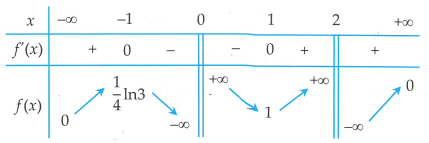
Dựa vào bảng biến thiên, ta thấy phương trình (1) có nghiệm duy nhất khi và chỉ khi
$\left[ \begin{aligned}
& m-505=0 \\
& m-505=\dfrac{1}{4}\ln 3 \\
& m-505=1 \\
\end{aligned} \right.\Leftrightarrow \left[ \begin{aligned}
& m=505 \\
& m=505+\dfrac{1}{4}\ln 3 \\
& m=506 \\
\end{aligned} \right.$.
Vậy tổng các giá trị nguyên của m thỏa mãn yêu cầu là $505+506=1011$.
$\ln \left| \dfrac{x-2}{x} \right|=\dfrac{3}{x-2}-\dfrac{1}{x}+4m-2020\Leftrightarrow \dfrac{1}{4x}-\dfrac{3}{4(x-2)}+\dfrac{1}{4}\ln \left| \dfrac{x-2}{x} \right|=m-505$ (1)
Xét hàm số $f(x)=\dfrac{1}{4\text{x}}-\dfrac{3}{4(x-2)}+\dfrac{1}{4}\ln \left| \dfrac{x-2}{x} \right|$ trên $\mathbb{R}\backslash \left\{ 0;2 \right\}$. Ta có
${f}'(x)=\dfrac{1}{4{{\text{x}}^{2}}}+\dfrac{3}{4{{(x-2)}^{2}}}+\dfrac{1}{4}\left[ \dfrac{1}{x-2}-\dfrac{1}{x} \right]=\dfrac{1}{{{(x-2)}^{2}}}-\dfrac{1}{4}\left[ \dfrac{1}{{{(x-2)}^{2}}}+\dfrac{1}{{{x}^{2}}}-\dfrac{2}{x(x-2)} \right]$
$=\dfrac{1}{{{(x-2)}^{2}}}-\dfrac{1}{4}{{\left( \dfrac{1}{x-2}-\dfrac{1}{x} \right)}^{2}}=\dfrac{1}{{{(x-2)}^{2}}}-\dfrac{1}{{{x}^{2}}{{(x-2)}^{2}}}=\dfrac{{{x}^{2}}-1}{{{x}^{2}}{{(x-2)}^{2}}}$
Khi đó, ta có bảng biến thiên của hàm số $f(x)$ :
Dựa vào bảng biến thiên, ta thấy phương trình (1) có nghiệm duy nhất khi và chỉ khi
$\left[ \begin{aligned}
& m-505=0 \\
& m-505=\dfrac{1}{4}\ln 3 \\
& m-505=1 \\
\end{aligned} \right.\Leftrightarrow \left[ \begin{aligned}
& m=505 \\
& m=505+\dfrac{1}{4}\ln 3 \\
& m=506 \\
\end{aligned} \right.$.
Vậy tổng các giá trị nguyên của m thỏa mãn yêu cầu là $505+506=1011$.
Đáp án C.