
 Google
Câu hỏi: Cho đường thẳng $y=\dfrac{3}{4}x$ và parabol $y=\dfrac{1}{2}{{x}^{2}}+a$, (a là tham số thực dương). Gọi ${{S}_{1}}, {{S}_{2}}$ lần lượt là diện tích của hai hình phẳng được gạch chéo trong hình vẽ bên. Khi ${{S}_{1}}={{S}_{2}}$ thì a thuộc khoảng nào dưới đây?
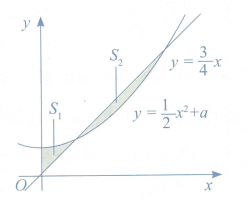 A. $\left( \dfrac{1}{4}; \dfrac{9}{32} \right)$
B. $\left( \dfrac{3}{16}; \dfrac{7}{32} \right)$
C. $\left( 0; \dfrac{3}{16} \right)$
D. $\left( \dfrac{7}{32}; \dfrac{1}{4} \right)$
B. $\left( \dfrac{3}{16}; \dfrac{7}{32} \right)$
C. $\left( 0; \dfrac{3}{16} \right)$
D. $\left( \dfrac{7}{32}; \dfrac{1}{4} \right)$
Phương trình hoành độ giao điểm $\dfrac{1}{2}{{x}^{2}}-\dfrac{3}{4}x+a=0\Leftrightarrow 2{{x}^{2}}-3x+4a=0$ (1)
Phương trình trên có 2 nghiệm dương phân biệt:
$\Leftrightarrow \left\{ \begin{aligned}
& \Delta >0 \\
& S>0 \\
& P>0 \\
\end{aligned} \right.\Leftrightarrow \left\{ \begin{aligned}
& 9-32a>0 \\
& \dfrac{3}{2}>0 \\
& 2a>0 \\
\end{aligned} \right.\Leftrightarrow 0<a<\dfrac{9}{32}$
Khi $0<a<\dfrac{9}{32}$ phương trình (1) có hai nghiệm dương phân biệt ${{x}_{1}}<{{x}_{2}}$,
${{S}_{1}}={{S}_{2}}\Leftrightarrow \int\limits_{0}^{{{x}_{1}}}{\left( \dfrac{1}{2}{{x}^{2}}-\dfrac{3}{4}x+a \right)dx}=\int\limits_{{{x}_{1}}}^{{{x}_{2}}}{\left( -\dfrac{1}{2}{{x}^{2}}+\dfrac{3}{4}x-a \right)}\Leftrightarrow \int\limits_{0}^{{{x}_{2}}}{\left( \dfrac{1}{2}{{x}^{2}}-\dfrac{3}{4}x+a \right)dx}=0$
$\Leftrightarrow \left( \dfrac{1}{6}{{x}^{3}}-\dfrac{3}{8}{{x}^{2}}+ax \right)\left| \begin{aligned}
& ^{{{x}_{2}}} \\
& _{0} \\
\end{aligned} \right.=0\Leftrightarrow \left( \dfrac{1}{6}x_{2}^{3}-\dfrac{3}{8}x_{2}^{2}+a{{x}_{2}} \right)=0\Rightarrow a=-\dfrac{x_{2}^{2}}{6}+\dfrac{3{{x}_{2}}}{8}$
Từ (1) suy ra $4a=-2x_{2}^{2}+3{{x}_{2}}$, thế vào (2) ta được: $\Leftrightarrow \dfrac{2x_{2}^{2}}{3}-\dfrac{3{{x}_{2}}}{4}=0\Rightarrow {{x}_{2}}=\dfrac{9}{8}$
$\Rightarrow a=\dfrac{27}{128}$. Vậy $a\in \left( \dfrac{3}{16}; \dfrac{7}{32} \right)$.
Phương trình trên có 2 nghiệm dương phân biệt:
$\Leftrightarrow \left\{ \begin{aligned}
& \Delta >0 \\
& S>0 \\
& P>0 \\
\end{aligned} \right.\Leftrightarrow \left\{ \begin{aligned}
& 9-32a>0 \\
& \dfrac{3}{2}>0 \\
& 2a>0 \\
\end{aligned} \right.\Leftrightarrow 0<a<\dfrac{9}{32}$
Khi $0<a<\dfrac{9}{32}$ phương trình (1) có hai nghiệm dương phân biệt ${{x}_{1}}<{{x}_{2}}$,
${{S}_{1}}={{S}_{2}}\Leftrightarrow \int\limits_{0}^{{{x}_{1}}}{\left( \dfrac{1}{2}{{x}^{2}}-\dfrac{3}{4}x+a \right)dx}=\int\limits_{{{x}_{1}}}^{{{x}_{2}}}{\left( -\dfrac{1}{2}{{x}^{2}}+\dfrac{3}{4}x-a \right)}\Leftrightarrow \int\limits_{0}^{{{x}_{2}}}{\left( \dfrac{1}{2}{{x}^{2}}-\dfrac{3}{4}x+a \right)dx}=0$
$\Leftrightarrow \left( \dfrac{1}{6}{{x}^{3}}-\dfrac{3}{8}{{x}^{2}}+ax \right)\left| \begin{aligned}
& ^{{{x}_{2}}} \\
& _{0} \\
\end{aligned} \right.=0\Leftrightarrow \left( \dfrac{1}{6}x_{2}^{3}-\dfrac{3}{8}x_{2}^{2}+a{{x}_{2}} \right)=0\Rightarrow a=-\dfrac{x_{2}^{2}}{6}+\dfrac{3{{x}_{2}}}{8}$
Từ (1) suy ra $4a=-2x_{2}^{2}+3{{x}_{2}}$, thế vào (2) ta được: $\Leftrightarrow \dfrac{2x_{2}^{2}}{3}-\dfrac{3{{x}_{2}}}{4}=0\Rightarrow {{x}_{2}}=\dfrac{9}{8}$
$\Rightarrow a=\dfrac{27}{128}$. Vậy $a\in \left( \dfrac{3}{16}; \dfrac{7}{32} \right)$.
Đáp án B.