
 Google
Câu hỏi: Xét hai số thực $a,b$ thỏa mãn ${{2}^{a+b-1}}+{{2}^{2a+2b-1}}\le 7{{\log }_{2}}\left( a+b \right)+3$ là hai số thực $x,y$ thỏa mãn ${{\log }_{{{x}^{2}}+{{y}^{2}}+2}}\left( 4x+6y-10 \right)=1$. Giá trị nhỏ nhất của biểu thức $P={{\left( 2a-x \right)}^{2}}+{{\left( b-y \right)}^{2}}$ bằng
A. $9-4\sqrt{2}$.
B. $\dfrac{11-6\sqrt{2}}{2}$.
C. $\dfrac{41-12\sqrt{5}}{5}$.
D. $\dfrac{21-8\sqrt{5}}{5}$.
Ta có ${{\log }_{{{x}^{2}}+{{y}^{2}}+2}}\left( 4x+6y-10 \right)=1\Leftrightarrow {{\left( x-2 \right)}^{2}}+{{\left( y-3 \right)}^{2}}=1\Rightarrow M\left( x;y \right)$ thuộc đường tròn có tâm $I\left( 2;3 \right)$, $R=1$.
Với giả thiết đầu tiên, ta đặt $t=a+b{{,}^{{}}}\left( t>0 \right)\Rightarrow {{2}^{t-1}}+{{2}^{2t-1}}\le 7{{\log }_{2}}t+3$
$\Leftrightarrow g\left( t \right)={{2}^{t-1}}+{{2}^{2t-1}}-7{{\log }_{2}}t-3\le {{0}^{{}}}\left( * \right)$.
Có ${g}'\left( t \right)={{2}^{t-1}}.\ln 2+{{2.2}^{2t-1}}.ln2-\dfrac{7}{t.\ln 2}$ ; ${{g}'}'\left( t \right)={{2}^{t-1}}.{{\ln }^{2}}2+{{4.2}^{2t-1}}.{{\ln }^{2}}2+\dfrac{7}{{{t}^{2}}\ln 2}>0$, $\forall t>0$.
Do đó ${g}'\left( t \right)=0$ có tối đa 1 nghiệm trên $\left( 0;+\infty \right)$ và $g\left( t \right)=0$ có tối đa 2 nghiệm trên $\left( 0;+\infty \right)$
Nhận thấy $g\left( 1 \right)=g\left( 2 \right)=0$, do đó $g\left( t \right)=0\Leftrightarrow t=1,t=2$.
Lập bảng xét dấu suy ra $\left( * \right)\Leftrightarrow 1\le t\le 2\Leftrightarrow 1\le a+b\le 2\Leftrightarrow 2\le 2a+2b\le 4$.
Do đó điểm $N\left( 2a;b \right)$ thuộc hình phẳng giới hạn bởi hai đường thẳng ${{d}_{1}}:x+2y-2=0$, ${{d}_{2}}:x+2y-4=0$ (tham khảo hình vẽ).
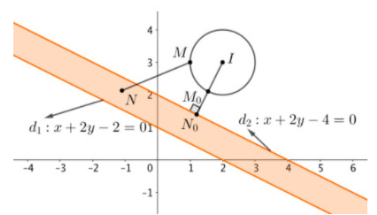 Khi đó $P=M{{N}^{2}}\ge {{\left( IN-IM \right)}^{2}}={{\left( IN-R \right)}^{2}}\ge {{\left( d\left( I,{{d}_{2}} \right)-R \right)}^{2}}={{\left( \dfrac{4}{\sqrt{5}}-1 \right)}^{2}}=\dfrac{21-8\sqrt{5}}{5}$.
A. $9-4\sqrt{2}$.
B. $\dfrac{11-6\sqrt{2}}{2}$.
C. $\dfrac{41-12\sqrt{5}}{5}$.
D. $\dfrac{21-8\sqrt{5}}{5}$.
Ta có ${{\log }_{{{x}^{2}}+{{y}^{2}}+2}}\left( 4x+6y-10 \right)=1\Leftrightarrow {{\left( x-2 \right)}^{2}}+{{\left( y-3 \right)}^{2}}=1\Rightarrow M\left( x;y \right)$ thuộc đường tròn có tâm $I\left( 2;3 \right)$, $R=1$.
Với giả thiết đầu tiên, ta đặt $t=a+b{{,}^{{}}}\left( t>0 \right)\Rightarrow {{2}^{t-1}}+{{2}^{2t-1}}\le 7{{\log }_{2}}t+3$
$\Leftrightarrow g\left( t \right)={{2}^{t-1}}+{{2}^{2t-1}}-7{{\log }_{2}}t-3\le {{0}^{{}}}\left( * \right)$.
Có ${g}'\left( t \right)={{2}^{t-1}}.\ln 2+{{2.2}^{2t-1}}.ln2-\dfrac{7}{t.\ln 2}$ ; ${{g}'}'\left( t \right)={{2}^{t-1}}.{{\ln }^{2}}2+{{4.2}^{2t-1}}.{{\ln }^{2}}2+\dfrac{7}{{{t}^{2}}\ln 2}>0$, $\forall t>0$.
Do đó ${g}'\left( t \right)=0$ có tối đa 1 nghiệm trên $\left( 0;+\infty \right)$ và $g\left( t \right)=0$ có tối đa 2 nghiệm trên $\left( 0;+\infty \right)$
Nhận thấy $g\left( 1 \right)=g\left( 2 \right)=0$, do đó $g\left( t \right)=0\Leftrightarrow t=1,t=2$.
Lập bảng xét dấu suy ra $\left( * \right)\Leftrightarrow 1\le t\le 2\Leftrightarrow 1\le a+b\le 2\Leftrightarrow 2\le 2a+2b\le 4$.
Do đó điểm $N\left( 2a;b \right)$ thuộc hình phẳng giới hạn bởi hai đường thẳng ${{d}_{1}}:x+2y-2=0$, ${{d}_{2}}:x+2y-4=0$ (tham khảo hình vẽ).
Đáp án D.