
 Google
Câu hỏi: Với các số thực x không âm và thỏa mãn ${{4}^{x}}-{{3.2}^{\sqrt{x}+x}}-{{4}^{\sqrt{x}+1}}\le 0$. Gọi S là tập hợp các giá trị nguyên của tham số m để phương trình ${{x}^{2}}+9x+1=m{{e}^{x}}$ có hai nghiệm phân biệt. Số phần tử của tập hợp S là:
A. 4.
B. 5.
C. 6.
D. 7.
A. 4.
B. 5.
C. 6.
D. 7.
Ta có: $\begin{aligned}
& {{4}^{x}}-{{3.2}^{\sqrt{x}+x}}-{{4}^{\sqrt{x}+1}}\le 0\Leftrightarrow {{4}^{x}}-{{3.2}^{\sqrt{x}+x}}-{{4.4}^{\sqrt{x}}}\le 0 \\
& \Leftrightarrow \dfrac{{{4}^{x}}}{{{4}^{\sqrt{x}}}}-3.\dfrac{{{2}^{x+\sqrt{x}}}}{{{4}^{\sqrt{x}}}}-4\le 0\Leftrightarrow {{4}^{x-\sqrt{x}}}-{{3.2}^{x-\sqrt{x}}}-4\le 0 \\
\end{aligned}$
Đặt $t={{2}^{x-\sqrt{x}}}\ge 0$ ta được:
${{t}^{2}}-3t-4\le 0\Leftrightarrow -1\le t\le 4\Leftrightarrow {{2}^{x-\sqrt{x}}}\le {{2}^{2}}\Leftrightarrow x-\sqrt{x}-2\le 0\Leftrightarrow \left( \sqrt{x}+1 \right)\left( \sqrt{x}-2 \right)\le 0\Leftrightarrow 0\le x\le 4$.
Phương trình ${{x}^{2}}+9x+1=m{{e}^{x}}\Leftrightarrow m=\dfrac{{{x}^{2}}+9x+1}{{{e}^{x}}}=g\left( x \right)$.
Lại có $g'\left( x \right)=\dfrac{\left( 2x+9 \right){{e}^{x}}-\left( {{x}^{2}}+9x+1 \right){{e}^{x}}}{{{e}^{2x}}}=\dfrac{-{{x}^{2}}-7x+8}{{{e}^{x}}}=0\Leftrightarrow \left[ \begin{aligned}
& x=1 \\
& x=-8 \\
\end{aligned} \right.$.
Ta có bảng biến thiên:
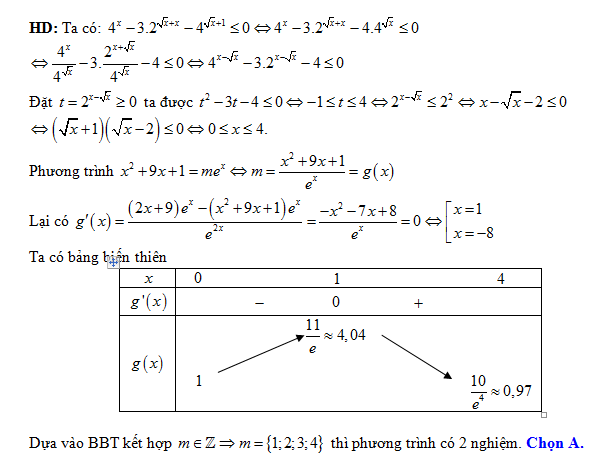 Dựa vào BBT kết hợp $m\in \mathbb{Z}\Rightarrow m=\left\{ 1;2;3;4 \right\}$ thì phương trình có 2 nghiệm.
& {{4}^{x}}-{{3.2}^{\sqrt{x}+x}}-{{4}^{\sqrt{x}+1}}\le 0\Leftrightarrow {{4}^{x}}-{{3.2}^{\sqrt{x}+x}}-{{4.4}^{\sqrt{x}}}\le 0 \\
& \Leftrightarrow \dfrac{{{4}^{x}}}{{{4}^{\sqrt{x}}}}-3.\dfrac{{{2}^{x+\sqrt{x}}}}{{{4}^{\sqrt{x}}}}-4\le 0\Leftrightarrow {{4}^{x-\sqrt{x}}}-{{3.2}^{x-\sqrt{x}}}-4\le 0 \\
\end{aligned}$
Đặt $t={{2}^{x-\sqrt{x}}}\ge 0$ ta được:
${{t}^{2}}-3t-4\le 0\Leftrightarrow -1\le t\le 4\Leftrightarrow {{2}^{x-\sqrt{x}}}\le {{2}^{2}}\Leftrightarrow x-\sqrt{x}-2\le 0\Leftrightarrow \left( \sqrt{x}+1 \right)\left( \sqrt{x}-2 \right)\le 0\Leftrightarrow 0\le x\le 4$.
Phương trình ${{x}^{2}}+9x+1=m{{e}^{x}}\Leftrightarrow m=\dfrac{{{x}^{2}}+9x+1}{{{e}^{x}}}=g\left( x \right)$.
Lại có $g'\left( x \right)=\dfrac{\left( 2x+9 \right){{e}^{x}}-\left( {{x}^{2}}+9x+1 \right){{e}^{x}}}{{{e}^{2x}}}=\dfrac{-{{x}^{2}}-7x+8}{{{e}^{x}}}=0\Leftrightarrow \left[ \begin{aligned}
& x=1 \\
& x=-8 \\
\end{aligned} \right.$.
Ta có bảng biến thiên:
Đáp án A.