
 Google
Câu hỏi: Điện phân dung dịch chứa đồng thời $\mathrm{NaCl}$ và $\mathrm{CuSO}_{4}$ (điện cực trơ, màng ngăn xốp, hiệu suất điện phân $100 \%$, bỏ qua sự hòa tan các khí trong nước và sự bay hơi nước) với cường độ dòng điện không đổi. Kết quả của thí nghiệm ghi ở bảng sau:
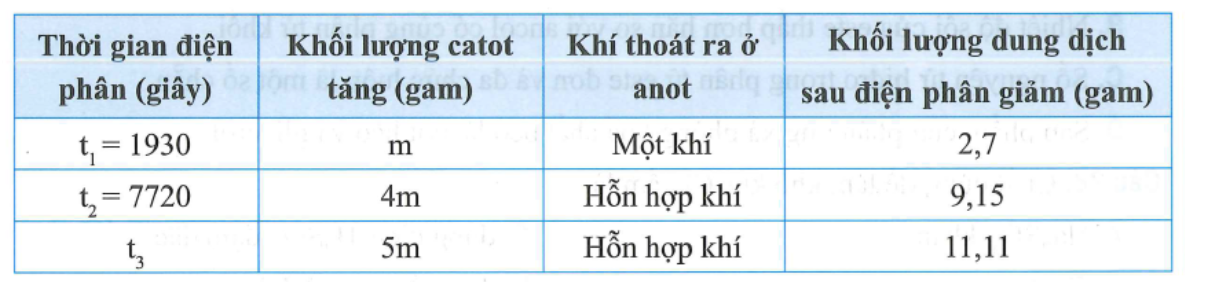
Tỷ lệ $\mathrm{t}_{3}: \mathrm{t}_{1}$ có giá trị là
A. $12$.
B. $6$.
C. $10$.
D. $4,2$.
Tỷ lệ $\mathrm{t}_{3}: \mathrm{t}_{1}$ có giá trị là
A. $12$.
B. $6$.
C. $10$.
D. $4,2$.
Khi $t_{1}=1930:$
$\text{C}{{\text{u}}^{2+}}+2\text{e}\to \text{Cu}$ $\mathrm{Cu}^{2+}+2 \mathrm{e} \rightarrow \mathrm{Cu} \quad 2 \mathrm{Cl}^{-} \rightarrow \mathrm{Cl}_{2}+2 \mathrm{e}$
$n_{\mathrm{Cu}}=\dfrac{m}{64} \rightarrow n_{\mathrm{e}}=\dfrac{2 m}{64} \rightarrow n_{\mathrm{Cl}_{2}}=\dfrac{m}{64}$
$m_{\mathrm{dd} \downarrow}=m_{\mathrm{Cu}}+m_{\mathrm{Cl}_{2}}=2,7$
$\rightarrow m+\dfrac{m}{64} .71=2,7 \rightarrow m=1,28$
$\rightarrow n_{\mathrm{e}}=\dfrac{2 m}{64}=0,04$
Khi $\mathrm{t}_{2}=7720$ : Khối lượng catot vẫn tăng chứng tỏ $\mathrm{CuSO}_{4}$ vẫn chưa điện phân hết. $n_{\mathrm{Cu}}=\dfrac{4 m}{64}=0,08 \rightarrow n_{\mathrm{e}}=0,16$
$\mathrm{Cu}^{2+}+2 \mathrm{e} \rightarrow \mathrm{Cu}$ $\begin{aligned}
& 2\text{C}{{\text{l}}^{-}}\to \text{C}{{\text{l}}_{2}}+2\text{e} \\
& x 2x \\
\end{aligned}$
$\begin{aligned}
& 2{{\text{H}}_{2}}\text{O}\to 4{{\text{H}}^{+}}+{{\text{O}}_{2}}+4\text{e} \\
& \text{y} 4y \\
\end{aligned}$
$\to \left\{ \begin{array}{*{35}{l}}
2x+4y=0,16\left( {{n}_{\uparrow }} \right) \\
71x+32y+4.1,28=9,15\left( {{m}_{\text{dd}\downarrow }} \right) \\
\end{array}\to \left\{ \begin{aligned}
& x=0,05 \\
& y=0,015 \\
\end{aligned} \right. \right.$
$\to {{n}_{\text{NaCl}}}={{n}_{\text{C}{{\text{l}}^{-}}}}=0,05.2=0,1$ (lúc này Fe( điện phân hết)
Khi thời gian $\mathrm{t}_{3}$ : Có thể $\mathrm{CuSO}_{4}$ đã điện phân hết và $\mathrm{H}_{2} \mathrm{O}$ ở catot đã điện phân.
$n_{\mathrm{Cu}}=\dfrac{5 m}{64}=0,1$
$\begin{aligned}
& \text{C}{{\text{u}}^{2+}}+2\text{e}\to \text{Cu} \\
& \text{0,2}\leftarrow \text{0,1} \\
\end{aligned} $ $ \begin{aligned}
& 2\text{C}{{\text{l}}^{-}}\to \text{C}{{\text{l}}_{2}}+2\text{e} \\
& \text{0,1} \to 0,05 0,1 \\
\end{aligned}$
$\begin{aligned}
& 2{{\text{H}}_{2}}\text{O}+2\text{e}\to 2\text{O}{{\text{H}}^{-}}+{{\text{H}}_{2}} \\
& 2a a \\
\end{aligned}$
$\begin{aligned}
& 2{{\text{H}}_{2}}\text{O}\to 4{{\text{H}}^{+}}+{{\text{O}}_{2}}+4\text{e} \\
& y 4y \\
\end{aligned}$
$\rightarrow\left\{\begin{array}{l}0,2+2 a=0,1+4 b \text { (BT e) } \\ 5.1,28+2 a+71.0,05+32 b=11,11\left(m_{\text {dd } \downarrow}\right)\end{array} \rightarrow\left\{\begin{array}{l}a=0,02 \\ b=0,035\end{array}\right.\right.$
$\rightarrow n_{\mathrm{e}}=0,2+2.0,02=0,24$
$\rightarrow \dfrac{t_{3}}{t_{1}}=\dfrac{n_{\mathrm{e}(3)}}{n_{\mathrm{e}(1)}}=\dfrac{0,24}{0,04}=6$
$\text{C}{{\text{u}}^{2+}}+2\text{e}\to \text{Cu}$ $\mathrm{Cu}^{2+}+2 \mathrm{e} \rightarrow \mathrm{Cu} \quad 2 \mathrm{Cl}^{-} \rightarrow \mathrm{Cl}_{2}+2 \mathrm{e}$
$n_{\mathrm{Cu}}=\dfrac{m}{64} \rightarrow n_{\mathrm{e}}=\dfrac{2 m}{64} \rightarrow n_{\mathrm{Cl}_{2}}=\dfrac{m}{64}$
$m_{\mathrm{dd} \downarrow}=m_{\mathrm{Cu}}+m_{\mathrm{Cl}_{2}}=2,7$
$\rightarrow m+\dfrac{m}{64} .71=2,7 \rightarrow m=1,28$
$\rightarrow n_{\mathrm{e}}=\dfrac{2 m}{64}=0,04$
Khi $\mathrm{t}_{2}=7720$ : Khối lượng catot vẫn tăng chứng tỏ $\mathrm{CuSO}_{4}$ vẫn chưa điện phân hết. $n_{\mathrm{Cu}}=\dfrac{4 m}{64}=0,08 \rightarrow n_{\mathrm{e}}=0,16$
$\mathrm{Cu}^{2+}+2 \mathrm{e} \rightarrow \mathrm{Cu}$ $\begin{aligned}
& 2\text{C}{{\text{l}}^{-}}\to \text{C}{{\text{l}}_{2}}+2\text{e} \\
& x 2x \\
\end{aligned}$
$\begin{aligned}
& 2{{\text{H}}_{2}}\text{O}\to 4{{\text{H}}^{+}}+{{\text{O}}_{2}}+4\text{e} \\
& \text{y} 4y \\
\end{aligned}$
$\to \left\{ \begin{array}{*{35}{l}}
2x+4y=0,16\left( {{n}_{\uparrow }} \right) \\
71x+32y+4.1,28=9,15\left( {{m}_{\text{dd}\downarrow }} \right) \\
\end{array}\to \left\{ \begin{aligned}
& x=0,05 \\
& y=0,015 \\
\end{aligned} \right. \right.$
$\to {{n}_{\text{NaCl}}}={{n}_{\text{C}{{\text{l}}^{-}}}}=0,05.2=0,1$ (lúc này Fe( điện phân hết)
Khi thời gian $\mathrm{t}_{3}$ : Có thể $\mathrm{CuSO}_{4}$ đã điện phân hết và $\mathrm{H}_{2} \mathrm{O}$ ở catot đã điện phân.
$n_{\mathrm{Cu}}=\dfrac{5 m}{64}=0,1$
$\begin{aligned}
& \text{C}{{\text{u}}^{2+}}+2\text{e}\to \text{Cu} \\
& \text{0,2}\leftarrow \text{0,1} \\
\end{aligned} $ $ \begin{aligned}
& 2\text{C}{{\text{l}}^{-}}\to \text{C}{{\text{l}}_{2}}+2\text{e} \\
& \text{0,1} \to 0,05 0,1 \\
\end{aligned}$
$\begin{aligned}
& 2{{\text{H}}_{2}}\text{O}+2\text{e}\to 2\text{O}{{\text{H}}^{-}}+{{\text{H}}_{2}} \\
& 2a a \\
\end{aligned}$
$\begin{aligned}
& 2{{\text{H}}_{2}}\text{O}\to 4{{\text{H}}^{+}}+{{\text{O}}_{2}}+4\text{e} \\
& y 4y \\
\end{aligned}$
$\rightarrow\left\{\begin{array}{l}0,2+2 a=0,1+4 b \text { (BT e) } \\ 5.1,28+2 a+71.0,05+32 b=11,11\left(m_{\text {dd } \downarrow}\right)\end{array} \rightarrow\left\{\begin{array}{l}a=0,02 \\ b=0,035\end{array}\right.\right.$
$\rightarrow n_{\mathrm{e}}=0,2+2.0,02=0,24$
$\rightarrow \dfrac{t_{3}}{t_{1}}=\dfrac{n_{\mathrm{e}(3)}}{n_{\mathrm{e}(1)}}=\dfrac{0,24}{0,04}=6$
Đáp án B.