
 Google
Câu hỏi: Có tất cả bao nhiêu gái trị nguyên dương của tham số m để phương trình $m=2{{\log }_{2}}\left( \dfrac{{{2}^{x+4}}-16}{{{2}^{x}}+1} \right)$ có nghiệm?
A. 8
B. 5
C. 6
D. 7
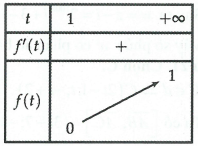
Điều kiện $\dfrac{{{2}^{x+4}}-16}{{{2}^{x}}+1}>0\Leftrightarrow {{2}^{x+4}}-16>0\Leftrightarrow {{2}^{x}}>1\Leftrightarrow x>0$
Phương trình tương đương
$m=2{{\log }_{2}}\left( \dfrac{{{2}^{x+4}}-16}{{{2}^{x}}+1} \right)\Leftrightarrow \dfrac{m}{2}={{\log }_{2}}16+{{\log }_{2}}\left( \dfrac{{{2}^{x}}-1}{{{2}^{x}}+1} \right)$
$\Leftrightarrow \dfrac{m}{2}-4={{\log }_{2}}\left( \dfrac{{{2}^{x}}-1}{{{2}^{x}}+1} \right)\Leftrightarrow \dfrac{{{2}^{x}}-1}{{{2}^{x}}+1}={{2}^{\dfrac{m}{2}-4}}\left( 1 \right)$
Đặt $t={{2}^{x}}$, do $x>0\Rightarrow t>1$
Xét hàm số $f\left( t \right)=\dfrac{t-1}{t+1}, t>1$
$f'\left( t \right)=\dfrac{2}{{{\left( t+1 \right)}^{2}}}>0,\forall t>1$
Căn cứ vào bảng biến thiên, ta thấy phương trình (1) có nghiệm khi và chỉ khi
$0<{{2}^{\dfrac{m}{2}-4}}<1\Leftrightarrow {{2}^{\dfrac{m}{2}-4}}<1\Leftrightarrow \dfrac{m}{2}-4<0\Leftrightarrow m<8$
Vậy có tất cả 7 giá trị nguyên dương cần tìm
Cách khác
Phương trình trương đương
$m=2{{\log }_{2}}\left( \dfrac{{{2}^{x+4}}-16}{{{2}^{x}}+1} \right)\Leftrightarrow \dfrac{m}{2}={{\log }_{2}}16+{{\log }_{2}}\left( \dfrac{{{2}^{x}}-1}{{{2}^{x}}+1} \right)\Leftrightarrow \dfrac{m}{2}-4={{\log }_{2}}\left( \dfrac{{{2}^{x}}-1}{{{2}^{x}}+1} \right)\left( 1 \right)$
Ta có $\dfrac{{{2}^{x}}-1}{{{2}^{x}}+1}=\dfrac{\left( {{2}^{x}}+1 \right)-2}{{{2}^{x}}+1}=1-\dfrac{2}{{{2}^{x}}+1}<1$
(vì $\forall x>0\Rightarrow {{2}^{x}}+1>2\Rightarrow 0<\dfrac{2}{{{2}^{x}}+1}<1\Rightarrow 1-\dfrac{2}{{{2}^{x}}+1}<1$ )
Như vậy ${{\log }_{2}}\left( \dfrac{{{2}^{x}}-1}{{{2}^{x}}+1} \right)<0,\forall x>0$
Do đó Phương trình (1) có nghiệm $\Leftrightarrow \dfrac{m}{2}-4<0\Leftrightarrow m<8$
Vậy có tất cả 7 giá trị nguyên dương cần tìm
A. 8
B. 5
C. 6
D. 7
Điều kiện $\dfrac{{{2}^{x+4}}-16}{{{2}^{x}}+1}>0\Leftrightarrow {{2}^{x+4}}-16>0\Leftrightarrow {{2}^{x}}>1\Leftrightarrow x>0$
Phương trình tương đương
$m=2{{\log }_{2}}\left( \dfrac{{{2}^{x+4}}-16}{{{2}^{x}}+1} \right)\Leftrightarrow \dfrac{m}{2}={{\log }_{2}}16+{{\log }_{2}}\left( \dfrac{{{2}^{x}}-1}{{{2}^{x}}+1} \right)$
$\Leftrightarrow \dfrac{m}{2}-4={{\log }_{2}}\left( \dfrac{{{2}^{x}}-1}{{{2}^{x}}+1} \right)\Leftrightarrow \dfrac{{{2}^{x}}-1}{{{2}^{x}}+1}={{2}^{\dfrac{m}{2}-4}}\left( 1 \right)$
Đặt $t={{2}^{x}}$, do $x>0\Rightarrow t>1$
Xét hàm số $f\left( t \right)=\dfrac{t-1}{t+1}, t>1$
$f'\left( t \right)=\dfrac{2}{{{\left( t+1 \right)}^{2}}}>0,\forall t>1$
Căn cứ vào bảng biến thiên, ta thấy phương trình (1) có nghiệm khi và chỉ khi
$0<{{2}^{\dfrac{m}{2}-4}}<1\Leftrightarrow {{2}^{\dfrac{m}{2}-4}}<1\Leftrightarrow \dfrac{m}{2}-4<0\Leftrightarrow m<8$
Vậy có tất cả 7 giá trị nguyên dương cần tìm
Cách khác
Phương trình trương đương
$m=2{{\log }_{2}}\left( \dfrac{{{2}^{x+4}}-16}{{{2}^{x}}+1} \right)\Leftrightarrow \dfrac{m}{2}={{\log }_{2}}16+{{\log }_{2}}\left( \dfrac{{{2}^{x}}-1}{{{2}^{x}}+1} \right)\Leftrightarrow \dfrac{m}{2}-4={{\log }_{2}}\left( \dfrac{{{2}^{x}}-1}{{{2}^{x}}+1} \right)\left( 1 \right)$
Ta có $\dfrac{{{2}^{x}}-1}{{{2}^{x}}+1}=\dfrac{\left( {{2}^{x}}+1 \right)-2}{{{2}^{x}}+1}=1-\dfrac{2}{{{2}^{x}}+1}<1$
(vì $\forall x>0\Rightarrow {{2}^{x}}+1>2\Rightarrow 0<\dfrac{2}{{{2}^{x}}+1}<1\Rightarrow 1-\dfrac{2}{{{2}^{x}}+1}<1$ )
Như vậy ${{\log }_{2}}\left( \dfrac{{{2}^{x}}-1}{{{2}^{x}}+1} \right)<0,\forall x>0$
Do đó Phương trình (1) có nghiệm $\Leftrightarrow \dfrac{m}{2}-4<0\Leftrightarrow m<8$
Vậy có tất cả 7 giá trị nguyên dương cần tìm
Đáp án D.