
 Google
Câu hỏi: Cho ${{x}^{2}}-xy+{{y}^{2}}=2$. Gọi M, m lần lượt là giá trị lớn nhất, giá trị nhỏ nhất của biểu thức $P={{x}^{2}}+xy+{{y}^{2}}$. Tính $M+m$.
A. $\dfrac{20}{3}.$
B. 6.
C. 7.
D. $\dfrac{22}{3}.$
A. $\dfrac{20}{3}.$
B. 6.
C. 7.
D. $\dfrac{22}{3}.$
Cách 1: Xét $\dfrac{P}{2}=\dfrac{{{x}^{2}}+xy+{{y}^{2}}}{2}=\dfrac{{{x}^{2}}+xy+{{y}^{2}}}{{{x}^{2}}-xy+{{y}^{2}}}$.
Trường hợp 1: Nếu $y=0$ thì ${{x}^{2}}=2$. Do đó $P={{x}^{2}}=2$ suy ra $\min P=2$.
Trường hợp 2: Nếu $y\ne 0$ ta chia tử mẫu cho ${{y}^{2}}$ ta được $\dfrac{P}{2}=\dfrac{{{x}^{2}}+xy+{{y}^{2}}}{{{x}^{2}}-xy+{{y}^{2}}}=\dfrac{1+\left( \dfrac{x}{y} \right)+{{\left( \dfrac{x}{y} \right)}^{2}}}{1-\left( \dfrac{x}{y} \right)+{{\left( \dfrac{x}{y} \right)}^{2}}}$. Đặt $\dfrac{x}{y}$, khi đó $\dfrac{P}{2}=\dfrac{1+t+{{t}^{2}}}{1-t+{{t}^{2}}}$.
Xét $f\left( t \right)=\dfrac{1+t+{{t}^{2}}}{1-t+{{t}^{2}}}\Rightarrow f'\left( t \right)=\dfrac{-2{{t}^{2}}+2}{{{\left( 1-t+{{t}^{2}} \right)}^{2}}}$. Khi đó $f'\left( t \right)=0\Leftrightarrow \left[ \begin{aligned}
& t=1 \\
& t=-1 \\
\end{aligned} \right.$.
Bảng biến thiên:
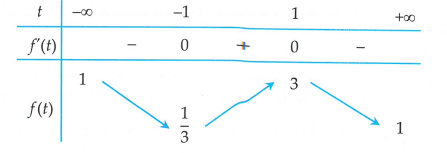 Khi đó $\dfrac{1}{3}\le \dfrac{P}{2}\le 3\Leftrightarrow \dfrac{2}{3}\le P\le 6.$
Do đó $\max P=6$, đạt được khi $x=y,\ \min P=\dfrac{2}{3}$, đạt được khi $x=-y.$
Vậy $M+m=\dfrac{20}{3}.$
Cách 2: Ta có: $\dfrac{P}{2}=\dfrac{1+t+{{t}^{2}}}{1-t+{{t}^{2}}}\Leftrightarrow \left( P-2 \right){{t}^{2}}-\left( P-2 \right)t+P-2=0\ \ \left( * \right)$.
Trường hợp 1: $P=2$.
Trường hợp 2: $P\ne 2$.
Phương trình (*) có nghiệm $\Leftrightarrow \Delta \ge 0\Leftrightarrow 3{{P}^{2}}-20P+12\le 0\Leftrightarrow \dfrac{2}{3}\le P\le 6.$
Do đó $M+m=\dfrac{20}{3}.$
Cách 3: Ta có $P={{x}^{2}}+xy+{{y}^{2}}=\left( {{x}^{2}}-xy+{{y}^{2}} \right)+2xy=2+2xy$.
Theo giả thiết ${{x}^{2}}-xy+{{y}^{2}}=2\Leftrightarrow 2-xy={{\left( x-y \right)}^{2}}\Rightarrow 2-xy\ge 0\Rightarrow xy\le 2\Rightarrow P\le 6.$
Dấu bằng xảy ra khi $x=y=\pm \sqrt{2}.$
Mặt khác ${{x}^{2}}-xy+{{y}^{2}}=2\Leftrightarrow 2+3xy={{\left( x+y \right)}^{2}}\Rightarrow 2+3xy\ge 0\Rightarrow xy\ge -\dfrac{2}{3}\Rightarrow P\ge \dfrac{2}{3}.$
Dấu bằng xảy ra khi $x=-y=\dfrac{\sqrt{6}}{3}$, hoặc $x=-y=-\dfrac{\sqrt{6}}{3}$.
Trường hợp 1: Nếu $y=0$ thì ${{x}^{2}}=2$. Do đó $P={{x}^{2}}=2$ suy ra $\min P=2$.
Trường hợp 2: Nếu $y\ne 0$ ta chia tử mẫu cho ${{y}^{2}}$ ta được $\dfrac{P}{2}=\dfrac{{{x}^{2}}+xy+{{y}^{2}}}{{{x}^{2}}-xy+{{y}^{2}}}=\dfrac{1+\left( \dfrac{x}{y} \right)+{{\left( \dfrac{x}{y} \right)}^{2}}}{1-\left( \dfrac{x}{y} \right)+{{\left( \dfrac{x}{y} \right)}^{2}}}$. Đặt $\dfrac{x}{y}$, khi đó $\dfrac{P}{2}=\dfrac{1+t+{{t}^{2}}}{1-t+{{t}^{2}}}$.
Xét $f\left( t \right)=\dfrac{1+t+{{t}^{2}}}{1-t+{{t}^{2}}}\Rightarrow f'\left( t \right)=\dfrac{-2{{t}^{2}}+2}{{{\left( 1-t+{{t}^{2}} \right)}^{2}}}$. Khi đó $f'\left( t \right)=0\Leftrightarrow \left[ \begin{aligned}
& t=1 \\
& t=-1 \\
\end{aligned} \right.$.
Bảng biến thiên:
Do đó $\max P=6$, đạt được khi $x=y,\ \min P=\dfrac{2}{3}$, đạt được khi $x=-y.$
Vậy $M+m=\dfrac{20}{3}.$
Cách 2: Ta có: $\dfrac{P}{2}=\dfrac{1+t+{{t}^{2}}}{1-t+{{t}^{2}}}\Leftrightarrow \left( P-2 \right){{t}^{2}}-\left( P-2 \right)t+P-2=0\ \ \left( * \right)$.
Trường hợp 1: $P=2$.
Trường hợp 2: $P\ne 2$.
Phương trình (*) có nghiệm $\Leftrightarrow \Delta \ge 0\Leftrightarrow 3{{P}^{2}}-20P+12\le 0\Leftrightarrow \dfrac{2}{3}\le P\le 6.$
Do đó $M+m=\dfrac{20}{3}.$
Cách 3: Ta có $P={{x}^{2}}+xy+{{y}^{2}}=\left( {{x}^{2}}-xy+{{y}^{2}} \right)+2xy=2+2xy$.
Theo giả thiết ${{x}^{2}}-xy+{{y}^{2}}=2\Leftrightarrow 2-xy={{\left( x-y \right)}^{2}}\Rightarrow 2-xy\ge 0\Rightarrow xy\le 2\Rightarrow P\le 6.$
Dấu bằng xảy ra khi $x=y=\pm \sqrt{2}.$
Mặt khác ${{x}^{2}}-xy+{{y}^{2}}=2\Leftrightarrow 2+3xy={{\left( x+y \right)}^{2}}\Rightarrow 2+3xy\ge 0\Rightarrow xy\ge -\dfrac{2}{3}\Rightarrow P\ge \dfrac{2}{3}.$
Dấu bằng xảy ra khi $x=-y=\dfrac{\sqrt{6}}{3}$, hoặc $x=-y=-\dfrac{\sqrt{6}}{3}$.
Đáp án A.