
 Google
Câu hỏi: Cho hàm số $f\left( x \right)=\dfrac{{{x}^{4}}}{4}-\dfrac{{{x}^{2}}}{2}-\dfrac{11}{4}.$ Phương trình $f\left( 4{{x}^{2}}-4x \right)+m=2$ có 2 nghiệm phân biệt khi m nhận các giá trị là
A. $m\ge \dfrac{19}{4}.$
B. $m>\dfrac{19}{4}.$
C. $m<\dfrac{19}{4}.$
D. $m\ge \dfrac{19}{4}.$
A. $m\ge \dfrac{19}{4}.$
B. $m>\dfrac{19}{4}.$
C. $m<\dfrac{19}{4}.$
D. $m\ge \dfrac{19}{4}.$
Cách 1: Đặt $t=4{{x}^{2}}-4x (1*)$, điều kiện là $t\ge -1.$
Từ (1*) ta có: $t=-1$ tương ứng với giá trị duy nhất $x=\dfrac{1}{2}.$
$t>-1$, mỗi giá trị t tương ứng với hai giá trị $x=\dfrac{1\pm \sqrt{1+t}}{2}$ phân biệt.
Xét hàm số $y=f\left( t \right)=\dfrac{{{t}^{4}}}{4}-\dfrac{{{t}^{2}}}{2}-\dfrac{11}{4}, t\ge -1; y'=0\Leftrightarrow {{t}^{3}}-t=0\Leftrightarrow \left[ \begin{aligned}
& t=0 \\
& t=\pm 1 \\
\end{aligned} \right.$
Bảng biến thiên của hàm số $y=\dfrac{{{t}^{4}}}{4}-\dfrac{{{t}^{2}}}{2}-\dfrac{11}{4}, t\ge -1$ :
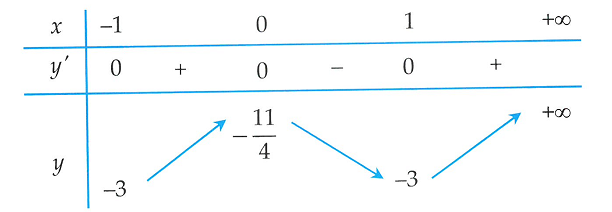 Phương trình $f\left( 4{{x}^{2}}-4x \right)+m=2$ có 2 nghiệm phân biệt
$\Leftrightarrow f\left( t \right)=2-m$ có nghiệm duy nhất $t>-1\Leftrightarrow -\dfrac{11}{4}<2-m\Leftrightarrow m<\dfrac{19}{4}.$
Cách 2: Ta có $f\left( x \right)=\dfrac{{{x}^{4}}}{4}-\dfrac{{{x}^{2}}}{2}-\dfrac{11}{4}\Rightarrow f'\left( x \right)={{x}^{3}}-x,\forall x\in \mathbb{R}.$
$f'\left( x \right)=0\Leftrightarrow {{x}^{3}}-x=0\Leftrightarrow \left[ \begin{aligned}
& x=0 \\
& x=\pm 1 \\
\end{aligned} \right..$
Đặt $y=f\left( 4{{x}^{2}}-4x \right)\Rightarrow y'=\left( 8x-4 \right).f'\left( 4{{x}^{2}}-4x \right).$
$y'=0\Leftrightarrow \left[ \begin{aligned}
& 8x-4=0 \\
& f'\left( 4{{x}^{2}}-4x \right)=0 \\
\end{aligned} \right.\Leftrightarrow \left[ \begin{aligned}
& x=\dfrac{1}{2} \\
& 4{{x}^{2}}-4x=0 \\
& 4{{x}^{2}}-4x=1 \\
& 4{{x}^{2}}-4x=-1 \\
\end{aligned} \right.\Leftrightarrow \left[ \begin{aligned}
& x=\dfrac{1}{2} \\
& x=0 \\
& x=1 \\
& x=\dfrac{1\pm \sqrt{2}}{2} \\
\end{aligned} \right.(*) $ trong (*), nghiệm $ x=\dfrac{1}{2}$ là nghiệm bội 3 hay bội lẻ, nghiệm còn lại là nghiệm đơn).
$\left\{ \begin{aligned}
& \underset{x\to \pm \infty }{\mathop{\lim }} \left( 4{{x}^{2}}-4x \right)=+\infty \\
& \underset{x\to +\infty }{\mathop{\lim }} f\left( x \right)=\underset{x\to +\infty }{\mathop{\lim }} \left( \dfrac{{{x}^{4}}}{4}-\dfrac{{{x}^{2}}}{2}-\dfrac{11}{4} \right)=+\infty \\
\end{aligned} \right.$
$\Rightarrow \underset{x\to \pm \infty }{\mathop{\lim }} f\left( 4{{x}^{2}}-4x \right)=\underset{\left( 4{{x}^{2}}-4x \right)\to +\infty }{\mathop{\lim }} f\left( 4{{x}^{2}}-4x \right)=+\infty .$
Bảng biến thiên của hàm số $y=f\left( 4{{x}^{2}}-4x \right)$ :
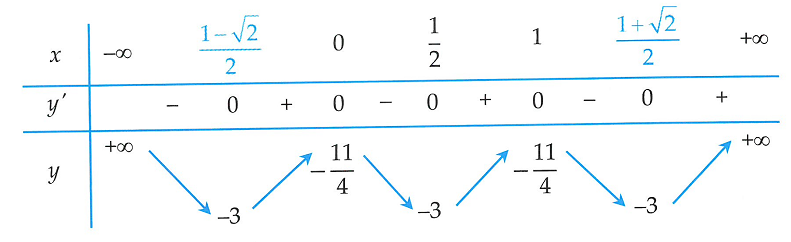 Phương trình $f\left( 4{{x}^{2}}-4x \right)+m=2$ có 2 nghiệm phân biệt
$\Leftrightarrow f\left( 4{{x}^{2}}-4x \right)=2-m$ có 2 nghiệm phân biệt $\Leftrightarrow -\dfrac{11}{4}<2-m\Leftrightarrow m<\dfrac{19}{4}.$
Từ (1*) ta có: $t=-1$ tương ứng với giá trị duy nhất $x=\dfrac{1}{2}.$
$t>-1$, mỗi giá trị t tương ứng với hai giá trị $x=\dfrac{1\pm \sqrt{1+t}}{2}$ phân biệt.
Xét hàm số $y=f\left( t \right)=\dfrac{{{t}^{4}}}{4}-\dfrac{{{t}^{2}}}{2}-\dfrac{11}{4}, t\ge -1; y'=0\Leftrightarrow {{t}^{3}}-t=0\Leftrightarrow \left[ \begin{aligned}
& t=0 \\
& t=\pm 1 \\
\end{aligned} \right.$
Bảng biến thiên của hàm số $y=\dfrac{{{t}^{4}}}{4}-\dfrac{{{t}^{2}}}{2}-\dfrac{11}{4}, t\ge -1$ :
$\Leftrightarrow f\left( t \right)=2-m$ có nghiệm duy nhất $t>-1\Leftrightarrow -\dfrac{11}{4}<2-m\Leftrightarrow m<\dfrac{19}{4}.$
Cách 2: Ta có $f\left( x \right)=\dfrac{{{x}^{4}}}{4}-\dfrac{{{x}^{2}}}{2}-\dfrac{11}{4}\Rightarrow f'\left( x \right)={{x}^{3}}-x,\forall x\in \mathbb{R}.$
$f'\left( x \right)=0\Leftrightarrow {{x}^{3}}-x=0\Leftrightarrow \left[ \begin{aligned}
& x=0 \\
& x=\pm 1 \\
\end{aligned} \right..$
Đặt $y=f\left( 4{{x}^{2}}-4x \right)\Rightarrow y'=\left( 8x-4 \right).f'\left( 4{{x}^{2}}-4x \right).$
$y'=0\Leftrightarrow \left[ \begin{aligned}
& 8x-4=0 \\
& f'\left( 4{{x}^{2}}-4x \right)=0 \\
\end{aligned} \right.\Leftrightarrow \left[ \begin{aligned}
& x=\dfrac{1}{2} \\
& 4{{x}^{2}}-4x=0 \\
& 4{{x}^{2}}-4x=1 \\
& 4{{x}^{2}}-4x=-1 \\
\end{aligned} \right.\Leftrightarrow \left[ \begin{aligned}
& x=\dfrac{1}{2} \\
& x=0 \\
& x=1 \\
& x=\dfrac{1\pm \sqrt{2}}{2} \\
\end{aligned} \right.(*) $ trong (*), nghiệm $ x=\dfrac{1}{2}$ là nghiệm bội 3 hay bội lẻ, nghiệm còn lại là nghiệm đơn).
$\left\{ \begin{aligned}
& \underset{x\to \pm \infty }{\mathop{\lim }} \left( 4{{x}^{2}}-4x \right)=+\infty \\
& \underset{x\to +\infty }{\mathop{\lim }} f\left( x \right)=\underset{x\to +\infty }{\mathop{\lim }} \left( \dfrac{{{x}^{4}}}{4}-\dfrac{{{x}^{2}}}{2}-\dfrac{11}{4} \right)=+\infty \\
\end{aligned} \right.$
$\Rightarrow \underset{x\to \pm \infty }{\mathop{\lim }} f\left( 4{{x}^{2}}-4x \right)=\underset{\left( 4{{x}^{2}}-4x \right)\to +\infty }{\mathop{\lim }} f\left( 4{{x}^{2}}-4x \right)=+\infty .$
Bảng biến thiên của hàm số $y=f\left( 4{{x}^{2}}-4x \right)$ :
$\Leftrightarrow f\left( 4{{x}^{2}}-4x \right)=2-m$ có 2 nghiệm phân biệt $\Leftrightarrow -\dfrac{11}{4}<2-m\Leftrightarrow m<\dfrac{19}{4}.$
Đáp án C.