
 Google
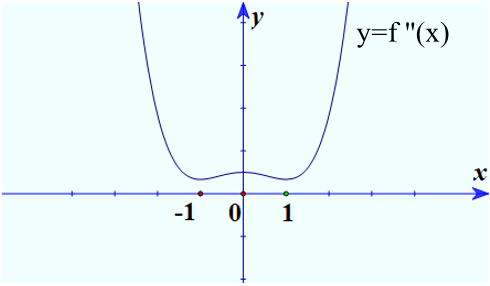
Câu hỏi: Cho hàm số $f\left( x \right)$ biết hàm số $y={{f}'}'(x)$ là hàm đa thức bậc 4 có đồ thị như hình vẽ.
Đặt $g(x)=2f\left( \dfrac{1}{2}{{x}^{2}} \right)+f\left( -{{x}^{2}}+6 \right)$, biết rằng $g(0)>0$ và $g\left( 2 \right)<0$. Tìm số điểm cực trị của hàm số $y=\left| g\left( x \right) \right|$.
A. $3$.
B. $5$.
C. $7$.
D. $6$.
Đặt $g(x)=2f\left( \dfrac{1}{2}{{x}^{2}} \right)+f\left( -{{x}^{2}}+6 \right)$, biết rằng $g(0)>0$ và $g\left( 2 \right)<0$. Tìm số điểm cực trị của hàm số $y=\left| g\left( x \right) \right|$.
A. $3$.
B. $5$.
C. $7$.
D. $6$.
Từ đồ thị hàm số $y={{f}'}'(x)$ ta có ${{f}'}'(x)>0 ,\forall x\in \mathbb{R}$ $\Rightarrow $ Hàm số $y={f}'\left( x \right)$ đồng biến trên $\mathbb{R}$.
${g}'(x)=2x.{f}'\left( \dfrac{1}{2}{{x}^{2}} \right)-2x.{f}'\left( -{{x}^{2}}+6 \right)=2x\left[ {f}'\left( \dfrac{1}{2}{{x}^{2}} \right)-{f}'\left( -{{x}^{2}}+6 \right) \right]$.
${g}'(x)=0\Leftrightarrow \left[ \begin{aligned}
& 2x=0 \\
& {f}'\left( \dfrac{1}{2}{{x}^{2}} \right)={f}'\left( -{{x}^{2}}+6 \right) \\
\end{aligned} \right.\Leftrightarrow \left[ \begin{aligned}
& x=0 \\
& \dfrac{1}{2}{{x}^{2}}=-{{x}^{2}}+6 \\
\end{aligned} \right.\Leftrightarrow \left[ \begin{aligned}
& x=0 \\
& x=-2 \\
& x=2 \\
\end{aligned} \right.$.
( do hàm số $y={f}'\left( x \right)$ đồng biến trên $\mathbb{R}$ )
Xét $g'(x)>0\Leftrightarrow $ $2x\left[ {f}'\left( \dfrac{1}{2}{{x}^{2}} \right)-{f}'\left( -{{x}^{2}}+6 \right) \right]>0\Leftrightarrow \left[ \begin{aligned}
& \left\{ \begin{aligned}
& x>0 \\
& \dfrac{1}{2}{{x}^{2}}>-{{x}^{2}}+6 \\
\end{aligned} \right. \\
& \left\{ \begin{aligned}
& x<0 \\
& \dfrac{1}{2}{{x}^{2}}<-{{x}^{2}}+6 \\
\end{aligned} \right. \\
\end{aligned} \right.\Leftrightarrow \left[ \begin{aligned}
& x>2 \\
& -2<x<0 \\
\end{aligned} \right.$.
Suy ra ${g}'(x)<0\Leftrightarrow \left[ \begin{aligned}
& x<-2 \\
& 0<x<2 \\
\end{aligned} \right.$.
Vì $g(x)=2f\left( \dfrac{1}{2}{{x}^{2}} \right)+f\left( -{{x}^{2}}+6 \right)$ là hàm số chẵn trên $\mathbb{R}$ và có $g\left( 2 \right)<0$ nên $g\left( -2 \right)=g\left( 2 \right)=a<0, g(0)=b>0$.
Bảng biến thiên của hàm số $g\left( x \right)$ :
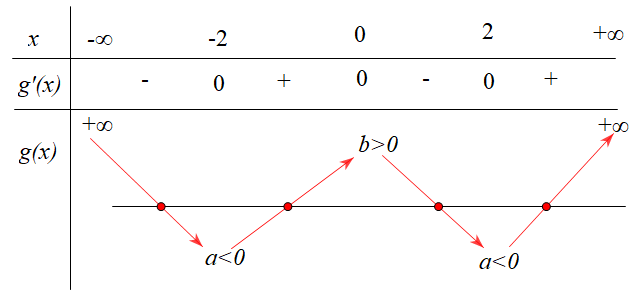
Vậy hàm số $y=\left| g(x) \right|$ có $7$ điểm cực trị.
${g}'(x)=2x.{f}'\left( \dfrac{1}{2}{{x}^{2}} \right)-2x.{f}'\left( -{{x}^{2}}+6 \right)=2x\left[ {f}'\left( \dfrac{1}{2}{{x}^{2}} \right)-{f}'\left( -{{x}^{2}}+6 \right) \right]$.
${g}'(x)=0\Leftrightarrow \left[ \begin{aligned}
& 2x=0 \\
& {f}'\left( \dfrac{1}{2}{{x}^{2}} \right)={f}'\left( -{{x}^{2}}+6 \right) \\
\end{aligned} \right.\Leftrightarrow \left[ \begin{aligned}
& x=0 \\
& \dfrac{1}{2}{{x}^{2}}=-{{x}^{2}}+6 \\
\end{aligned} \right.\Leftrightarrow \left[ \begin{aligned}
& x=0 \\
& x=-2 \\
& x=2 \\
\end{aligned} \right.$.
( do hàm số $y={f}'\left( x \right)$ đồng biến trên $\mathbb{R}$ )
Xét $g'(x)>0\Leftrightarrow $ $2x\left[ {f}'\left( \dfrac{1}{2}{{x}^{2}} \right)-{f}'\left( -{{x}^{2}}+6 \right) \right]>0\Leftrightarrow \left[ \begin{aligned}
& \left\{ \begin{aligned}
& x>0 \\
& \dfrac{1}{2}{{x}^{2}}>-{{x}^{2}}+6 \\
\end{aligned} \right. \\
& \left\{ \begin{aligned}
& x<0 \\
& \dfrac{1}{2}{{x}^{2}}<-{{x}^{2}}+6 \\
\end{aligned} \right. \\
\end{aligned} \right.\Leftrightarrow \left[ \begin{aligned}
& x>2 \\
& -2<x<0 \\
\end{aligned} \right.$.
Suy ra ${g}'(x)<0\Leftrightarrow \left[ \begin{aligned}
& x<-2 \\
& 0<x<2 \\
\end{aligned} \right.$.
Vì $g(x)=2f\left( \dfrac{1}{2}{{x}^{2}} \right)+f\left( -{{x}^{2}}+6 \right)$ là hàm số chẵn trên $\mathbb{R}$ và có $g\left( 2 \right)<0$ nên $g\left( -2 \right)=g\left( 2 \right)=a<0, g(0)=b>0$.
Bảng biến thiên của hàm số $g\left( x \right)$ :
Vậy hàm số $y=\left| g(x) \right|$ có $7$ điểm cực trị.
Đáp án C.