
 Google
Câu hỏi: Cho hàm số bậc bốn $f\left( x \right)=a{{x}^{4}}+b{{x}^{3}}+c{{x}^{2}}+dx+a$ có đồ thị hàm số $y=f'\left( x \right)$ là đường cong như hình vẽ sau:
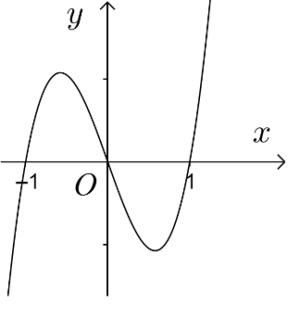 Hàm số $y=f\left( 2x-1 \right)f\left( {{x}^{2}}-2x \right)$ có bao nhiêu điểm cực trị?
A. $3.$
B. $7.$
C. $4.$
D. $1.$
$f\left( x \right)=a{{x}^{4}}+b{{x}^{3}}+c{{x}^{2}}+dx+a\Rightarrow {f}'\left( x \right)=4a{{x}^{3}}+3b{{x}^{2}}+2cx+d$.
Dựa vào đồ thị hàm số ${f}'\left( x \right)$ ta có $\underset{x\to +\infty }{\mathop{\lim }} {f}'\left( x \right)=+\infty \Rightarrow 4a>0\Leftrightarrow a>0.$
Hàm số ${f}'\left( x \right)$ cắt trục hoành tại 3 điểm có hoành độ lần lượt là $-1;0;1$ nên ta có hệ phương trình sau:
$\left\{ \begin{aligned}
& d=0 \\
& -4a+3b-2c+d=0 \\
& 4a+3b+2c+d=0 \\
\end{aligned} \right.\Leftrightarrow \left\{ \begin{aligned}
& d=0 \\
& b=0 \\
& c=-2a \\
\end{aligned} \right.\Rightarrow f\left( x \right)=a{{x}^{4}}-2a{{x}^{2}}+a=a\left( {{x}^{4}}-2{{x}^{2}}+1 \right)$.
Bảng biến thiên của hàm số $f\left( x \right)$ như sau:
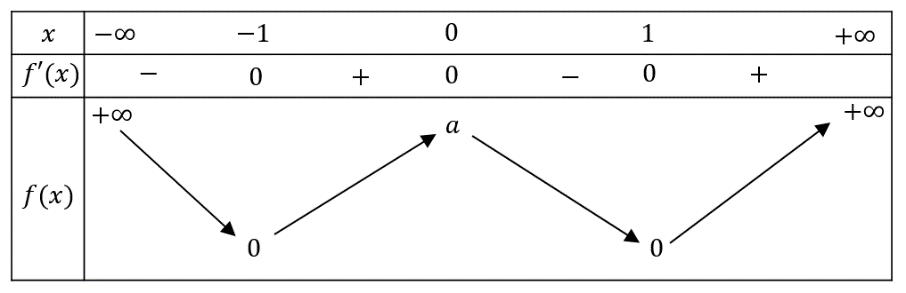 Đặt $g\left( x \right)=f\left( 2x-1 \right)f\left( {{x}^{2}}-2x \right)$.
Ta có $g\left( x \right)=0\Leftrightarrow \left[ \begin{aligned}
& f\left( 2x-1 \right)=0 \\
& f\left( {{x}^{2}}-2x \right)=0 \\
\end{aligned} \right.\Leftrightarrow \left[ \begin{aligned}
& 2x-1=-1 \\
& 2x-1=1 \\
& {{x}^{2}}-2x=-1 \\
& {{x}^{2}}-2x=1 \\
\end{aligned} \right.\Leftrightarrow \left[ \begin{aligned}
& x=0 \\
& x=1 \\
& x=1+\sqrt{2} \\
& x=1-\sqrt{2} \\
\end{aligned} \right.$.
Phương trình $g\left( x \right)=0$ có bốn nghiệm nhưng đều là nghiệm bội chẵn.
Ta có $\underset{x\to +\infty }{\mathop{\lim }} g\left( x \right)=\underset{x\to -\infty }{\mathop{\lim }} g\left( x \right)=+\infty $. Suy ra hàm số $y=g\left( x \right)$ có dạng như sau:
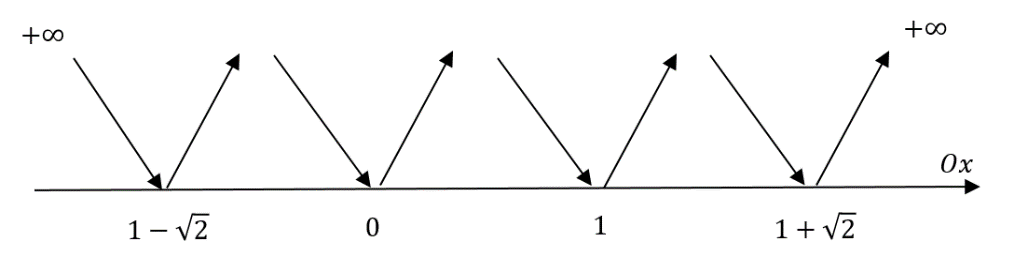 Kết luận hàm số $y=f\left( 2x-1 \right)f\left( {{x}^{2}}-2x \right)$ có 7 điểm cực trị.
A. $3.$
B. $7.$
C. $4.$
D. $1.$
$f\left( x \right)=a{{x}^{4}}+b{{x}^{3}}+c{{x}^{2}}+dx+a\Rightarrow {f}'\left( x \right)=4a{{x}^{3}}+3b{{x}^{2}}+2cx+d$.
Dựa vào đồ thị hàm số ${f}'\left( x \right)$ ta có $\underset{x\to +\infty }{\mathop{\lim }} {f}'\left( x \right)=+\infty \Rightarrow 4a>0\Leftrightarrow a>0.$
Hàm số ${f}'\left( x \right)$ cắt trục hoành tại 3 điểm có hoành độ lần lượt là $-1;0;1$ nên ta có hệ phương trình sau:
$\left\{ \begin{aligned}
& d=0 \\
& -4a+3b-2c+d=0 \\
& 4a+3b+2c+d=0 \\
\end{aligned} \right.\Leftrightarrow \left\{ \begin{aligned}
& d=0 \\
& b=0 \\
& c=-2a \\
\end{aligned} \right.\Rightarrow f\left( x \right)=a{{x}^{4}}-2a{{x}^{2}}+a=a\left( {{x}^{4}}-2{{x}^{2}}+1 \right)$.
Bảng biến thiên của hàm số $f\left( x \right)$ như sau:
Ta có $g\left( x \right)=0\Leftrightarrow \left[ \begin{aligned}
& f\left( 2x-1 \right)=0 \\
& f\left( {{x}^{2}}-2x \right)=0 \\
\end{aligned} \right.\Leftrightarrow \left[ \begin{aligned}
& 2x-1=-1 \\
& 2x-1=1 \\
& {{x}^{2}}-2x=-1 \\
& {{x}^{2}}-2x=1 \\
\end{aligned} \right.\Leftrightarrow \left[ \begin{aligned}
& x=0 \\
& x=1 \\
& x=1+\sqrt{2} \\
& x=1-\sqrt{2} \\
\end{aligned} \right.$.
Phương trình $g\left( x \right)=0$ có bốn nghiệm nhưng đều là nghiệm bội chẵn.
Ta có $\underset{x\to +\infty }{\mathop{\lim }} g\left( x \right)=\underset{x\to -\infty }{\mathop{\lim }} g\left( x \right)=+\infty $. Suy ra hàm số $y=g\left( x \right)$ có dạng như sau:
Đáp án B.