
 Google
Câu hỏi: Cho hàm số bậc ba $y=f\left( x \right)$ có $f\left( -1 \right)+f\left( 3 \right)=0$ và có đồ thị của hàm số $y={f}'\left( x \right)$ như sau:
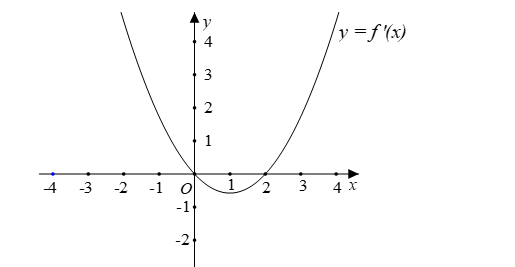 Hỏi hàm số $y={{\left[ f\left( 4{{x}^{3}}-6{{x}^{2}}+2 \right) \right]}^{4}}$ có bao nhiêu điểm cực đại?
A. $4$.
B. $6$.
C. $9$.
D. $5$.
Hàm số bậc ba $y=f\left( x \right)=a{{x}^{3}}+b{{x}^{2}}+cx+d \left( a\ne 0 \right)$.
Ta có ${y}'={f}'(x)=3a{{x}^{2}}+2bx+c$.
Đồ thị hàm số ${f}'(x)$ đi qua các điểm $\left( 0;0 \right),\left( 2;0 \right)$ và có hệ số $a>0$.
Ta có hệ phương trình
$\left\{ \begin{aligned}
& c=0 \\
& 12a+4b+c=0 \\
\end{aligned} \right.\Leftrightarrow \left\{ \begin{aligned}
& c=0 \\
& b=-3a \\
\end{aligned} \right. $ $ \Rightarrow f\left( x \right)=a{{x}^{3}}-3a{{x}^{2}}+d $.
Ta lại có $f\left( -1 \right)+f\left( 3 \right)=0\Leftrightarrow -a-3a+d+27a-27a+d=0\Leftrightarrow d=2a$.
Khi đó $f\left( x \right)=a\left( {{x}^{3}}-3{{x}^{2}}+2 \right)$ với $a>0$.
Ta có $f\left( x \right)=0\Leftrightarrow {{x}^{3}}-3{{x}^{2}}+2=0\Leftrightarrow \left[ \begin{aligned}
& x=1-\sqrt{3} \\
& x=1+\sqrt{3} \\
& x=1 \\
\end{aligned} \right.$.
Đặt $g\left( x \right)={{\left[ f\left( 4{{x}^{3}}-6{{x}^{2}}+2 \right) \right]}^{4}}$.
Ta có ${g}'\left( x \right)=4.{{\left[ f\left( 4{{x}^{3}}-6{{x}^{2}}+2 \right) \right]}^{3}}.\left( 12{{x}^{2}}-12x \right){f}'\left( 4{{x}^{3}}-6{{x}^{2}}+2 \right)$.
${g}'\left( x \right)=0\Leftrightarrow \left[ \begin{aligned}
& f\left( 4{{x}^{3}}-6{{x}^{2}}+2 \right)=0 \\
& 12{{x}^{2}}-12x=0 \\
& {f}'\left( 4{{x}^{3}}-6{{x}^{2}}+2 \right)=0 \\
\end{aligned} \right.$.
$f\left( 4{{x}^{3}}-6{{x}^{2}}+2 \right)=0\Leftrightarrow \left[ \begin{aligned}
& 4{{x}^{3}}-6{{x}^{2}}+2=1+\sqrt{3} \\
& 4{{x}^{3}}-6{{x}^{2}}+2=1-\sqrt{3} \\
& 4{{x}^{3}}-6{{x}^{2}}+2=1 \\
\end{aligned} \right.\Leftrightarrow \left[ \begin{aligned}
& x={{x}_{1}} \left( {{x}_{1}}\approx 1.57 \right) \\
& x={{x}_{2}}\left( {{x}_{2}}\approx -0.57 \right) \\
& x=\dfrac{1-\sqrt{3}}{2}\vee x=\dfrac{1+\sqrt{3}}{2}\vee x=\dfrac{1}{2} \\
\end{aligned} \right.$.
$12{{x}^{2}}-12x=0\Leftrightarrow \left[ \begin{aligned}
& x=0 \\
& x=1 \\
\end{aligned} \right.$.
${f}'\left( 4{{x}^{3}}-6{{x}^{2}}+2 \right)=0\Leftrightarrow \left[ \begin{aligned}
& 4{{x}^{3}}-6{{x}^{2}}+2=0 \\
& 4{{x}^{3}}-6{{x}^{2}}+2=2 \\
\end{aligned} \right.\Leftrightarrow \left[ \begin{aligned}
& x=-\dfrac{1}{2}\vee x=1 (kep) \\
& x=\dfrac{3}{2}\vee x=0 (kep) \\
\end{aligned} \right.$.
Phương trình ${g}'(x)=0$ có 9 nghiệm bội lẻ.
Ta thấy ${g}'(2)=4{{\left[ f\left( 10 \right) \right]}^{3}}.{f}'\left( 10 \right).24>0$.
Vậy, hàm số $g\left( x \right)={{\left[ f\left( 4{{x}^{3}}-6{{x}^{2}}+2 \right) \right]}^{4}}$ có 4 điểm cực đại.
A. $4$.
B. $6$.
C. $9$.
D. $5$.
Hàm số bậc ba $y=f\left( x \right)=a{{x}^{3}}+b{{x}^{2}}+cx+d \left( a\ne 0 \right)$.
Ta có ${y}'={f}'(x)=3a{{x}^{2}}+2bx+c$.
Đồ thị hàm số ${f}'(x)$ đi qua các điểm $\left( 0;0 \right),\left( 2;0 \right)$ và có hệ số $a>0$.
Ta có hệ phương trình
$\left\{ \begin{aligned}
& c=0 \\
& 12a+4b+c=0 \\
\end{aligned} \right.\Leftrightarrow \left\{ \begin{aligned}
& c=0 \\
& b=-3a \\
\end{aligned} \right. $ $ \Rightarrow f\left( x \right)=a{{x}^{3}}-3a{{x}^{2}}+d $.
Ta lại có $f\left( -1 \right)+f\left( 3 \right)=0\Leftrightarrow -a-3a+d+27a-27a+d=0\Leftrightarrow d=2a$.
Khi đó $f\left( x \right)=a\left( {{x}^{3}}-3{{x}^{2}}+2 \right)$ với $a>0$.
Ta có $f\left( x \right)=0\Leftrightarrow {{x}^{3}}-3{{x}^{2}}+2=0\Leftrightarrow \left[ \begin{aligned}
& x=1-\sqrt{3} \\
& x=1+\sqrt{3} \\
& x=1 \\
\end{aligned} \right.$.
Đặt $g\left( x \right)={{\left[ f\left( 4{{x}^{3}}-6{{x}^{2}}+2 \right) \right]}^{4}}$.
Ta có ${g}'\left( x \right)=4.{{\left[ f\left( 4{{x}^{3}}-6{{x}^{2}}+2 \right) \right]}^{3}}.\left( 12{{x}^{2}}-12x \right){f}'\left( 4{{x}^{3}}-6{{x}^{2}}+2 \right)$.
${g}'\left( x \right)=0\Leftrightarrow \left[ \begin{aligned}
& f\left( 4{{x}^{3}}-6{{x}^{2}}+2 \right)=0 \\
& 12{{x}^{2}}-12x=0 \\
& {f}'\left( 4{{x}^{3}}-6{{x}^{2}}+2 \right)=0 \\
\end{aligned} \right.$.
$f\left( 4{{x}^{3}}-6{{x}^{2}}+2 \right)=0\Leftrightarrow \left[ \begin{aligned}
& 4{{x}^{3}}-6{{x}^{2}}+2=1+\sqrt{3} \\
& 4{{x}^{3}}-6{{x}^{2}}+2=1-\sqrt{3} \\
& 4{{x}^{3}}-6{{x}^{2}}+2=1 \\
\end{aligned} \right.\Leftrightarrow \left[ \begin{aligned}
& x={{x}_{1}} \left( {{x}_{1}}\approx 1.57 \right) \\
& x={{x}_{2}}\left( {{x}_{2}}\approx -0.57 \right) \\
& x=\dfrac{1-\sqrt{3}}{2}\vee x=\dfrac{1+\sqrt{3}}{2}\vee x=\dfrac{1}{2} \\
\end{aligned} \right.$.
$12{{x}^{2}}-12x=0\Leftrightarrow \left[ \begin{aligned}
& x=0 \\
& x=1 \\
\end{aligned} \right.$.
${f}'\left( 4{{x}^{3}}-6{{x}^{2}}+2 \right)=0\Leftrightarrow \left[ \begin{aligned}
& 4{{x}^{3}}-6{{x}^{2}}+2=0 \\
& 4{{x}^{3}}-6{{x}^{2}}+2=2 \\
\end{aligned} \right.\Leftrightarrow \left[ \begin{aligned}
& x=-\dfrac{1}{2}\vee x=1 (kep) \\
& x=\dfrac{3}{2}\vee x=0 (kep) \\
\end{aligned} \right.$.
Phương trình ${g}'(x)=0$ có 9 nghiệm bội lẻ.
Ta thấy ${g}'(2)=4{{\left[ f\left( 10 \right) \right]}^{3}}.{f}'\left( 10 \right).24>0$.
Vậy, hàm số $g\left( x \right)={{\left[ f\left( 4{{x}^{3}}-6{{x}^{2}}+2 \right) \right]}^{4}}$ có 4 điểm cực đại.
Đáp án A.