

 Google
Câu hỏi: Cho hai số thực dương $x,y$ thỏa mãn ${{\log }_{3}}{{\left[ \left( {{x}^{2}}+2 \right)\left( y+1 \right) \right]}^{y+1}}=9-{{x}^{2}}\left( y+1 \right).$ Giá trị nhỏ nhất của biểu thức $P={{x}^{2}}+2y$ bằng
A. $-5+6\sqrt{3}$
B. $\dfrac{11}{2}$
C. $-4+6\sqrt{2}$
D. $\dfrac{27}{5}$
A. $-5+6\sqrt{3}$
B. $\dfrac{11}{2}$
C. $-4+6\sqrt{2}$
D. $\dfrac{27}{5}$
Cách giải:
Ta có: ${{\log }_{3}}{{\left[ \left( {{x}^{2}}+2 \right)\left( y+1 \right) \right]}^{y+1}}=9-{{x}^{2}}\left( y+1 \right)\Leftrightarrow \left( y+1 \right){{\log }_{3}}\left[ \left( {{x}^{2}}+2 \right)\left( y+1 \right) \right]=9-{{x}^{2}}\left( y+1 \right)$
$\Leftrightarrow {{\log }_{3}}\left( {{x}^{2}}+2 \right)+{{\log }_{3}}\left( y+1 \right)=\dfrac{9}{y+1}-{{x}^{2}}\Leftrightarrow {{\log }_{3}}\left( {{x}^{2}}+2 \right)+{{x}^{2}}+2=\dfrac{9}{y+1}+{{\log }_{3}}\left( y+1 \right)+2$
$\Leftrightarrow {{\log }_{3}}\left( {{x}^{2}}+2 \right)+{{x}^{2}}+2=\dfrac{9}{y+1}+{{\log }_{3}}\dfrac{1}{y+1}+{{\log }_{3}}9$
$\Leftrightarrow {{\log }_{3}}\left( {{x}^{2}}+2 \right)+{{x}^{2}}+2={{\log }_{3}}\dfrac{9}{y+1}+\dfrac{9}{y+1}\left( * \right)$
Xét hàm số đặc trưng: ${{\log }_{3}}t+t,t>0\Rightarrow f'\left( t \right)=\dfrac{1}{t\ln 3}+1>0,\forall t>0$
Do đó hàm số $f\left( t \right)$ đồng biến trên $\left( 0;+\infty \right)$
Khi đó: ${{x}^{2}}+2=\dfrac{9}{y+1}\Leftrightarrow {{x}^{2}}=\dfrac{9}{y+1}-2.$
$P=\dfrac{9}{y+1}+2y-2,y>0$
$P'=-\dfrac{9}{{{\left( y+1 \right)}^{2}}}+2=0\Leftrightarrow \left[ \begin{aligned}
& y+1=\dfrac{3\sqrt{2}}{2} \\
& y+1=-\dfrac{3\sqrt{2}}{2} \\
\end{aligned} \right.\Leftrightarrow \left[ \begin{aligned}
& y=\dfrac{3\sqrt{2}}{2}-1 \\
& y=-\dfrac{3\sqrt{2}}{2}-1 \\
\end{aligned} \right.$
Mà điều kiện $x,y>0$ nên $y=\dfrac{3\sqrt{2}}{2}-1.$
Bảng biến thiên:
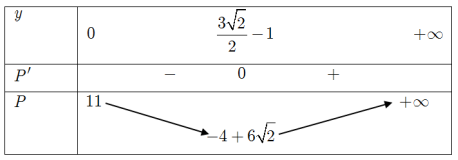
Từ bảng biến thiên ta thấy giá trị nhỏ nhất của $P$ là $-4+6\sqrt{2}.$
Ta có: ${{\log }_{3}}{{\left[ \left( {{x}^{2}}+2 \right)\left( y+1 \right) \right]}^{y+1}}=9-{{x}^{2}}\left( y+1 \right)\Leftrightarrow \left( y+1 \right){{\log }_{3}}\left[ \left( {{x}^{2}}+2 \right)\left( y+1 \right) \right]=9-{{x}^{2}}\left( y+1 \right)$
$\Leftrightarrow {{\log }_{3}}\left( {{x}^{2}}+2 \right)+{{\log }_{3}}\left( y+1 \right)=\dfrac{9}{y+1}-{{x}^{2}}\Leftrightarrow {{\log }_{3}}\left( {{x}^{2}}+2 \right)+{{x}^{2}}+2=\dfrac{9}{y+1}+{{\log }_{3}}\left( y+1 \right)+2$
$\Leftrightarrow {{\log }_{3}}\left( {{x}^{2}}+2 \right)+{{x}^{2}}+2=\dfrac{9}{y+1}+{{\log }_{3}}\dfrac{1}{y+1}+{{\log }_{3}}9$
$\Leftrightarrow {{\log }_{3}}\left( {{x}^{2}}+2 \right)+{{x}^{2}}+2={{\log }_{3}}\dfrac{9}{y+1}+\dfrac{9}{y+1}\left( * \right)$
Xét hàm số đặc trưng: ${{\log }_{3}}t+t,t>0\Rightarrow f'\left( t \right)=\dfrac{1}{t\ln 3}+1>0,\forall t>0$
Do đó hàm số $f\left( t \right)$ đồng biến trên $\left( 0;+\infty \right)$
Khi đó: ${{x}^{2}}+2=\dfrac{9}{y+1}\Leftrightarrow {{x}^{2}}=\dfrac{9}{y+1}-2.$
$P=\dfrac{9}{y+1}+2y-2,y>0$
$P'=-\dfrac{9}{{{\left( y+1 \right)}^{2}}}+2=0\Leftrightarrow \left[ \begin{aligned}
& y+1=\dfrac{3\sqrt{2}}{2} \\
& y+1=-\dfrac{3\sqrt{2}}{2} \\
\end{aligned} \right.\Leftrightarrow \left[ \begin{aligned}
& y=\dfrac{3\sqrt{2}}{2}-1 \\
& y=-\dfrac{3\sqrt{2}}{2}-1 \\
\end{aligned} \right.$
Mà điều kiện $x,y>0$ nên $y=\dfrac{3\sqrt{2}}{2}-1.$
Bảng biến thiên:
Từ bảng biến thiên ta thấy giá trị nhỏ nhất của $P$ là $-4+6\sqrt{2}.$
Đáp án C.