

 Google
Câu hỏi: Cho hai hàm số $f\left( x \right)=a{{x}^{3}}-3{{x}^{2}}+bx+1-2d$ và $g\left( x \right)=c{{x}^{2}}-2x+d$ có bảng biến thiên như sau:
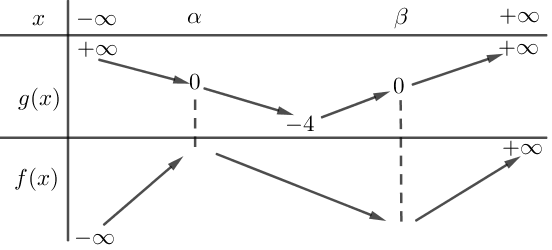 Biết rằng đồ thị hai hàm số đã cho cắt nhau tại ba điểm phân biệt có hoành độ ${{x}_{1}}, {{x}_{2}}, {{x}_{3}}$ thỏa mãn ${{x}_{1}}^{2}+{{x}_{2}}^{2}+{{x}_{3}}^{2}=30$. Diện tích hình phẳng giới hạn bởi các đường cong $y=f\left( x \right), y=g\left( x \right), x=-3, x=6$ bằng:
A. $\dfrac{2113}{12}$.
B. $\dfrac{1123}{12}$.
C. $\dfrac{1231}{12}$.
D. $\dfrac{1321}{12}$.
A. $\dfrac{2113}{12}$.
B. $\dfrac{1123}{12}$.
C. $\dfrac{1231}{12}$.
D. $\dfrac{1321}{12}$.
Ta có: $f'\left( x \right)=3a{{x}^{2}}-6x+b$.
Dựa vào bảng biến thiên ta thấy hàm $y=g\left( x \right)$ giao với trục hoành tại hai điểm có hoành độ chính là hai hoành độ cực trị của đồ thị hàm $y=f\left( x \right)$ nên ta suy ra $g\left( x \right)=k.{f}'\left( x \right)$
Do đó: $g\left( x \right)=k.{f}'\left( x \right)\Leftrightarrow c{{x}^{2}}-2x+d=k\left( 3a{{x}^{2}}-6x+b \right)\Leftrightarrow \left\{ \begin{aligned}
& c=3ka \\
& 2=6k \\
& d=kb \\
\end{aligned} \right.\Leftrightarrow \left\{ \begin{aligned}
& k=\dfrac{1}{3} \\
& c=a \\
& d=\dfrac{b}{3} \\
\end{aligned} \right.$.
Suy ra: $f\left( x \right)=a{{x}^{3}}-3{{x}^{2}}+bx+2;g\left( x \right)=a{{x}^{2}}-2x+\dfrac{b}{3}$.
Từ bảng biến thiên ta có: $g\left( \dfrac{1}{a} \right)=-4\Leftrightarrow -\dfrac{1}{a}+\dfrac{3}{b}=-4\Leftrightarrow b=\dfrac{3}{a}-12 $.
Phương trình hoành độ giao điểm: $a{{x}^{3}}-3{{x}^{2}}+bx+2=a{{x}^{2}}-2x+\dfrac{b}{3}\Leftrightarrow a{{x}^{3}}+\left( -3-a \right){{x}^{2}}+\left( b+2 \right)x+2-\dfrac{b}{3}=0$
Viet: $x_{1}^{2}+x_{2}^{2}+x_{3}^{2}={{\left( {{x}_{1}}+{{x}_{2}}+{{x}_{3}} \right)}^{2}}-2\left( {{x}_{1}}{{x}_{2}}+{{x}_{2}}{{x}_{3}}+{{x}_{1}}{{x}_{3}} \right)$
$\Leftrightarrow 30={{\left( \dfrac{a+3}{a} \right)}^{2}}-2.\dfrac{b+2}{a}\Leftrightarrow 30={{\left( \dfrac{a+3}{a} \right)}^{2}}-2.\dfrac{\dfrac{3}{a}-10}{a}\Leftrightarrow \left[ \begin{aligned}
& a=1 \\
& a=-\dfrac{3}{29} \\
\end{aligned} \right.\Rightarrow a=1 $ ( vì $ a>0$)
Suy ra: $f\left( x \right)-g\left( x \right)={{x}^{3}}-4{{x}^{2}}-7x+10=0\Leftrightarrow \left[ \begin{aligned}
& x=-2 \\
& x=1 \\
& x=5 \\
\end{aligned} \right.$.
Vậy diện tích hình phẳng giới hạn bởi các đường cong $y=f\left( x \right), y=g\left( x \right), x=-3, x=6$ bằng:
$S=\int\limits_{-3}^{6}{\left| {{x}^{3}}-4{{x}^{2}}-7x+10 \right|dx}=\dfrac{1321}{12}$.
Dựa vào bảng biến thiên ta thấy hàm $y=g\left( x \right)$ giao với trục hoành tại hai điểm có hoành độ chính là hai hoành độ cực trị của đồ thị hàm $y=f\left( x \right)$ nên ta suy ra $g\left( x \right)=k.{f}'\left( x \right)$
Do đó: $g\left( x \right)=k.{f}'\left( x \right)\Leftrightarrow c{{x}^{2}}-2x+d=k\left( 3a{{x}^{2}}-6x+b \right)\Leftrightarrow \left\{ \begin{aligned}
& c=3ka \\
& 2=6k \\
& d=kb \\
\end{aligned} \right.\Leftrightarrow \left\{ \begin{aligned}
& k=\dfrac{1}{3} \\
& c=a \\
& d=\dfrac{b}{3} \\
\end{aligned} \right.$.
Suy ra: $f\left( x \right)=a{{x}^{3}}-3{{x}^{2}}+bx+2;g\left( x \right)=a{{x}^{2}}-2x+\dfrac{b}{3}$.
Từ bảng biến thiên ta có: $g\left( \dfrac{1}{a} \right)=-4\Leftrightarrow -\dfrac{1}{a}+\dfrac{3}{b}=-4\Leftrightarrow b=\dfrac{3}{a}-12 $.
Phương trình hoành độ giao điểm: $a{{x}^{3}}-3{{x}^{2}}+bx+2=a{{x}^{2}}-2x+\dfrac{b}{3}\Leftrightarrow a{{x}^{3}}+\left( -3-a \right){{x}^{2}}+\left( b+2 \right)x+2-\dfrac{b}{3}=0$
Viet: $x_{1}^{2}+x_{2}^{2}+x_{3}^{2}={{\left( {{x}_{1}}+{{x}_{2}}+{{x}_{3}} \right)}^{2}}-2\left( {{x}_{1}}{{x}_{2}}+{{x}_{2}}{{x}_{3}}+{{x}_{1}}{{x}_{3}} \right)$
$\Leftrightarrow 30={{\left( \dfrac{a+3}{a} \right)}^{2}}-2.\dfrac{b+2}{a}\Leftrightarrow 30={{\left( \dfrac{a+3}{a} \right)}^{2}}-2.\dfrac{\dfrac{3}{a}-10}{a}\Leftrightarrow \left[ \begin{aligned}
& a=1 \\
& a=-\dfrac{3}{29} \\
\end{aligned} \right.\Rightarrow a=1 $ ( vì $ a>0$)
Suy ra: $f\left( x \right)-g\left( x \right)={{x}^{3}}-4{{x}^{2}}-7x+10=0\Leftrightarrow \left[ \begin{aligned}
& x=-2 \\
& x=1 \\
& x=5 \\
\end{aligned} \right.$.
Vậy diện tích hình phẳng giới hạn bởi các đường cong $y=f\left( x \right), y=g\left( x \right), x=-3, x=6$ bằng:
$S=\int\limits_{-3}^{6}{\left| {{x}^{3}}-4{{x}^{2}}-7x+10 \right|dx}=\dfrac{1321}{12}$.
Đáp án D.