

 Google
Câu hỏi: Cho đường cong $\left( C \right): y={{x}^{3}}+mx+2$ (với $m$ là tham số thực) và parabol $\left( P \right): y=-{{x}^{2}}+2$ tạo thành hai miền phẳng có diện tích ${{S}_{1}}, {{S}_{2}}$ như hình vẽ sau:
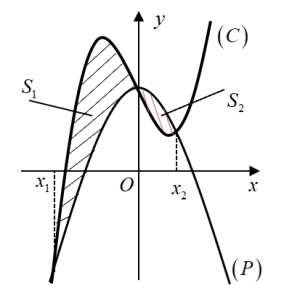 Biết ${{S}_{1}}=\dfrac{8}{3}$, giá trị của ${{S}_{2}}$ bằng
A. $\dfrac{5}{12}$.
B. $\dfrac{1}{2}$.
C. $\dfrac{3}{4}$.
D. $\dfrac{1}{4}$.
A. $\dfrac{5}{12}$.
B. $\dfrac{1}{2}$.
C. $\dfrac{3}{4}$.
D. $\dfrac{1}{4}$.
Phương trình hoành độ giao điểm của $\left( C \right)$ và $\left( P \right)$ là:
${{x}^{3}}+mx+2=-{{x}^{2}}+2\Leftrightarrow {{x}^{3}}+{{x}^{2}}+mx=0\Leftrightarrow x\left( {{x}^{2}}+x+m \right)=0\Leftrightarrow \left[ \begin{aligned}
& x=0 \\
& f\left( x \right)={{x}^{2}}+x+m=0 \left( * \right) \\
\end{aligned} \right.$.
Phương trình $\left( * \right)$ có hai nghiệm trái dấu ${{x}_{1}}, {{x}_{2}}$ $\Leftrightarrow ac<0\Leftrightarrow m<0$.
Vì ${{x}_{1}}$ là nghiệm của phương trình $\left( * \right)$ nên $x_{1}^{2}+{{x}_{1}}+m=0\Leftrightarrow m=-x_{1}^{2}-{{x}_{1}}$.
${{S}_{1}}=\int\limits_{{{x}_{1}}}^{0}{\left( {{x}^{3}}+{{x}^{2}}+mx \right)\text{d}x}=\left. \left( \dfrac{1}{4}{{x}^{4}}+\dfrac{1}{3}{{x}^{3}}+\dfrac{m}{2}{{x}^{2}} \right) \right|_{{{x}_{1}}}^{0}=-x_{1}^{2}\left( \dfrac{1}{4}x_{1}^{2}+\dfrac{1}{3}{{x}_{1}}+\dfrac{m}{2} \right)$ $=-x_{1}^{2}\left( -\dfrac{1}{4}x_{1}^{2}-\dfrac{1}{6}{{x}_{1}} \right)$
$=\dfrac{1}{4}x_{1}^{4}+\dfrac{1}{6}x_{1}^{3}$.
Theo giả thiết ${{S}_{1}}=\dfrac{8}{3}\Leftrightarrow \dfrac{1}{4}x_{1}^{4}+\dfrac{1}{6}x_{1}^{3}-\dfrac{8}{3}=0\Leftrightarrow {{x}_{1}}=-2$ (vì ${{x}_{1}}<0$ ) $\Rightarrow m=-2$.
Ta có ${{x}_{1}}+{{x}_{2}}=-1\Leftrightarrow {{x}_{2}}=1$.
Vậy ${{S}_{2}}=-\int\limits_{0}^{1}{\left( {{x}^{3}}+{{x}^{2}}-2x \right)\text{d}x}=\dfrac{5}{12}$.
${{x}^{3}}+mx+2=-{{x}^{2}}+2\Leftrightarrow {{x}^{3}}+{{x}^{2}}+mx=0\Leftrightarrow x\left( {{x}^{2}}+x+m \right)=0\Leftrightarrow \left[ \begin{aligned}
& x=0 \\
& f\left( x \right)={{x}^{2}}+x+m=0 \left( * \right) \\
\end{aligned} \right.$.
Phương trình $\left( * \right)$ có hai nghiệm trái dấu ${{x}_{1}}, {{x}_{2}}$ $\Leftrightarrow ac<0\Leftrightarrow m<0$.
Vì ${{x}_{1}}$ là nghiệm của phương trình $\left( * \right)$ nên $x_{1}^{2}+{{x}_{1}}+m=0\Leftrightarrow m=-x_{1}^{2}-{{x}_{1}}$.
${{S}_{1}}=\int\limits_{{{x}_{1}}}^{0}{\left( {{x}^{3}}+{{x}^{2}}+mx \right)\text{d}x}=\left. \left( \dfrac{1}{4}{{x}^{4}}+\dfrac{1}{3}{{x}^{3}}+\dfrac{m}{2}{{x}^{2}} \right) \right|_{{{x}_{1}}}^{0}=-x_{1}^{2}\left( \dfrac{1}{4}x_{1}^{2}+\dfrac{1}{3}{{x}_{1}}+\dfrac{m}{2} \right)$ $=-x_{1}^{2}\left( -\dfrac{1}{4}x_{1}^{2}-\dfrac{1}{6}{{x}_{1}} \right)$
$=\dfrac{1}{4}x_{1}^{4}+\dfrac{1}{6}x_{1}^{3}$.
Theo giả thiết ${{S}_{1}}=\dfrac{8}{3}\Leftrightarrow \dfrac{1}{4}x_{1}^{4}+\dfrac{1}{6}x_{1}^{3}-\dfrac{8}{3}=0\Leftrightarrow {{x}_{1}}=-2$ (vì ${{x}_{1}}<0$ ) $\Rightarrow m=-2$.
Ta có ${{x}_{1}}+{{x}_{2}}=-1\Leftrightarrow {{x}_{2}}=1$.
Vậy ${{S}_{2}}=-\int\limits_{0}^{1}{\left( {{x}^{3}}+{{x}^{2}}-2x \right)\text{d}x}=\dfrac{5}{12}$.
Đáp án A.