
 Google
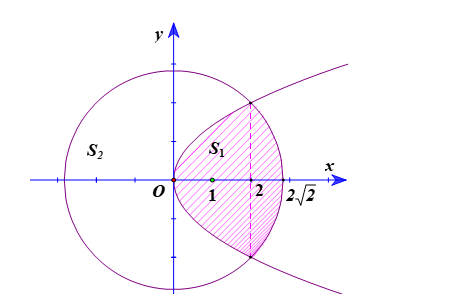
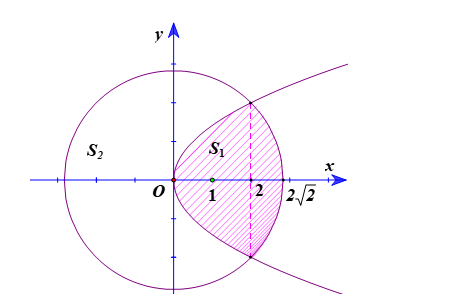
Câu hỏi: Biết rằng parabol $\left( P \right): {{y}^{2}}=2x$ chia đường tròn $\left( C \right): {{x}^{2}}+{{y}^{2}}=8$ thành hai phần lần lượt có diện tích là ${{S}_{1}}$, ${{S}_{2}}$ (như hình vẽ). Khi đó ${{S}_{2}}-{{S}_{1}}=a\pi -\dfrac{b}{c}$ với $a,b,c$ nguyên dương và $\dfrac{b}{c}$ là phân số tối giản. Tính $S=a+b+c$.
A. $S=13$.
B. $S=16$.
C. $S=15$
D. $S=14$.
Xét hệ $\left\{ \begin{aligned}
& {{x}^{2}}+{{y}^{2}}=8 \\
& {{y}^{2}}=2x \\
\end{aligned} \right. $ $ \Leftrightarrow \left\{ \begin{aligned}
& {{x}^{2}}+2x-8=0 \\
& {{y}^{2}}=2x \\
\end{aligned} \right. $ $ \Leftrightarrow \left\{ \begin{aligned}
& x=-4\vee x=2 \\
& {{y}^{2}}=2x \\
\end{aligned} \right. $ $ \Leftrightarrow \left\{ \begin{aligned}
& x=2 \\
& {{y}^{2}}=4 \\
\end{aligned} \right.$.
${{S}_{1}}=2\int\limits_{0}^{2}{\sqrt{2x}\text{d}x}+2\int\limits_{2}^{2\sqrt{2}}{\sqrt{8-{{x}^{2}}}}\text{d}x$
${{I}_{1}}=2\int\limits_{0}^{2}{\sqrt{2x}\text{d}x}=\left. \left( 2.\sqrt{2}.\dfrac{2}{3}\sqrt{{{x}^{3}}} \right) \right|_{0}^{2}=\dfrac{16}{3}$.
${{I}_{2}}=2\int\limits_{2}^{2\sqrt{2}}{\sqrt{8-{{x}^{2}}}}\text{d}x$
Đặt $x=2\sqrt{2}\cos t$ $\Rightarrow \text{d}x=-2\sqrt{2}\sin t\text{d}t$
$x=2\Rightarrow t=\dfrac{\pi }{4}$, $x=2\sqrt{2}\Rightarrow t=0$.
${{I}_{2}}=2\int\limits_{\dfrac{\pi }{4}}^{0}{\sqrt{8-8{{\cos }^{2}}t}\left( -2\sqrt{2}\sin t\text{d}t \right)}$ $=16\int\limits_{0}^{\dfrac{\pi }{4}}{{{\sin }^{2}}t\text{d}t}$ $=8\int\limits_{0}^{\dfrac{\pi }{4}}{\left( 1-\cos 2t \right)\text{d}t}$ $=8\left. \left( t-\dfrac{1}{2}\sin 2t \right) \right|_{0}^{\dfrac{\pi }{4}}$ $=2\pi -4$.
$\Rightarrow {{S}_{1}}={{I}_{1}}+{{I}_{2}}=2\pi +\dfrac{4}{3}$.
$\Rightarrow {{S}_{2}}=\pi {{\left( 2\sqrt{2} \right)}^{2}}-{{S}_{1}}=6\pi -\dfrac{4}{3}$.
$\Rightarrow {{S}_{2}}-{{S}_{1}}=4\pi -\dfrac{8}{3}$.
Vậy $a=4$, $=8$, $c=3$ $\Rightarrow S=a+b+c=15$.
A. $S=13$.
B. $S=16$.
C. $S=15$
D. $S=14$.
Xét hệ $\left\{ \begin{aligned}
& {{x}^{2}}+{{y}^{2}}=8 \\
& {{y}^{2}}=2x \\
\end{aligned} \right. $ $ \Leftrightarrow \left\{ \begin{aligned}
& {{x}^{2}}+2x-8=0 \\
& {{y}^{2}}=2x \\
\end{aligned} \right. $ $ \Leftrightarrow \left\{ \begin{aligned}
& x=-4\vee x=2 \\
& {{y}^{2}}=2x \\
\end{aligned} \right. $ $ \Leftrightarrow \left\{ \begin{aligned}
& x=2 \\
& {{y}^{2}}=4 \\
\end{aligned} \right.$.
${{S}_{1}}=2\int\limits_{0}^{2}{\sqrt{2x}\text{d}x}+2\int\limits_{2}^{2\sqrt{2}}{\sqrt{8-{{x}^{2}}}}\text{d}x$
${{I}_{1}}=2\int\limits_{0}^{2}{\sqrt{2x}\text{d}x}=\left. \left( 2.\sqrt{2}.\dfrac{2}{3}\sqrt{{{x}^{3}}} \right) \right|_{0}^{2}=\dfrac{16}{3}$.
${{I}_{2}}=2\int\limits_{2}^{2\sqrt{2}}{\sqrt{8-{{x}^{2}}}}\text{d}x$
Đặt $x=2\sqrt{2}\cos t$ $\Rightarrow \text{d}x=-2\sqrt{2}\sin t\text{d}t$
$x=2\Rightarrow t=\dfrac{\pi }{4}$, $x=2\sqrt{2}\Rightarrow t=0$.
${{I}_{2}}=2\int\limits_{\dfrac{\pi }{4}}^{0}{\sqrt{8-8{{\cos }^{2}}t}\left( -2\sqrt{2}\sin t\text{d}t \right)}$ $=16\int\limits_{0}^{\dfrac{\pi }{4}}{{{\sin }^{2}}t\text{d}t}$ $=8\int\limits_{0}^{\dfrac{\pi }{4}}{\left( 1-\cos 2t \right)\text{d}t}$ $=8\left. \left( t-\dfrac{1}{2}\sin 2t \right) \right|_{0}^{\dfrac{\pi }{4}}$ $=2\pi -4$.
$\Rightarrow {{S}_{1}}={{I}_{1}}+{{I}_{2}}=2\pi +\dfrac{4}{3}$.
$\Rightarrow {{S}_{2}}=\pi {{\left( 2\sqrt{2} \right)}^{2}}-{{S}_{1}}=6\pi -\dfrac{4}{3}$.
$\Rightarrow {{S}_{2}}-{{S}_{1}}=4\pi -\dfrac{8}{3}$.
Vậy $a=4$, $=8$, $c=3$ $\Rightarrow S=a+b+c=15$.
Đáp án C.