
 Google
Câu hỏi: Có bao nhiêu cặp số nguyên $\left( a;b \right)$ thỏa mãn $1<a<b<100$ để phương trình
${{a}^{{{b}^{x}}}}={{b}^{{{a}^{x}}}}$ có nghiệm nhỏ hơn 1?
A. $4751$
B. $4656~~$
C. $2$
D. $4750~$
${{a}^{{{b}^{x}}}}={{b}^{{{a}^{x}}}}$ có nghiệm nhỏ hơn 1?
A. $4751$
B. $4656~~$
C. $2$
D. $4750~$
Phương pháp:
- Sử dụng: $b=c>0\Leftrightarrow {{\log }_{a}}b={{\log }_{a}}c (0<a\ne 1)$.
- Lấy logarit $~2$ vế để hạ bậc, đưa $x$ về dưới dạng thừa số.
- Sử dụng điều kiện $x<1$ để giải bài toán.
Cách giải:
Do $1<a<b<100$ nên ta có:
$\begin{aligned}
& {{a}^{{{b}^{x}}}}={{b}^{{{a}^{x}}}}>0 \\
& \Leftrightarrow {{\log }_{a}}{{a}^{{{b}^{x}}}}={{\log }_{a}}{{b}^{{{a}^{x}}}} \\
& \Leftrightarrow {{b}^{x}}.{{\log }_{a}}a={{a}^{x}}{{\log }_{a}}b \\
\end{aligned}$
$\begin{aligned}
& \Leftrightarrow {{b}^{x}}={{a}^{x}}.{{\log }_{a}}b \\
& \Leftrightarrow {{\left( \dfrac{b}{a} \right)}^{x}}={{\log }_{a}}b \\
& \Leftrightarrow x={{\log }_{\dfrac{b}{a}}}\left( {{\log }_{a}}b \right) \\
\end{aligned}$
Phương trình đã cho có nghiệm nhỏ hơn 1 nên ta có:
$\begin{array}{*{35}{l}}
{{\log }_{\dfrac{b}{a}}}\left( {{\log }_{a}}b \right)<1\Leftrightarrow {{\log }_{a}}b<\dfrac{b}{a}\left( \text{Do }a<b\Rightarrow \dfrac{b}{a}>1 \right) \\
\Leftrightarrow b<{{a}^{\dfrac{b}{a}}}\Leftrightarrow {{b}^{a}}<{{\left( {{a}^{\dfrac{b}{a}}} \right)}^{a}}(\text{Do }a>1) \\
\end{array}$
$\begin{array}{*{35}{l}}
\Leftrightarrow {{b}^{a}}<{{a}^{b}} \\
\Leftrightarrow {{\log }_{a}}{{b}^{a}}<{{\log }_{a}}{{a}^{b}} (\text{Do }a>1) \\
\Leftrightarrow a.{{\log }_{a}}b<b (1) \\
\end{array}$
Đặt ${{\log }_{a}}b=t\Rightarrow b={{a}^{t}}$ thì $(1)\Leftrightarrow a.t<{{a}^{t}}$ với $b>a>1\Rightarrow t>1$.
Do $1<a<b<100;a,b\in \mathbb{Z}$ nên ta có:
+) Với $a=2$ thì ${{2}^{t}}>2t\Leftrightarrow {{2}^{t}}-2t>0$
Xét hàm số $f(t)={{2}^{t}}-2t$ ta có: $f'(t)={{2}^{t}}.\ln 2-2>0$
BBT của hàm số $f\left( t \right)$ trên khoảng $\left( 1;+\infty \right)$ như sau:
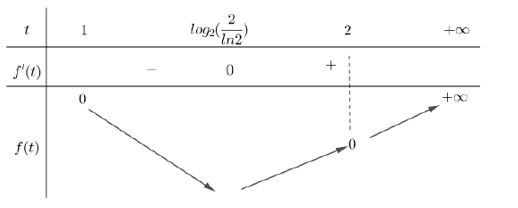
Từ BBT trên ta thấy $f(t)>0\Leftrightarrow t>2\Leftrightarrow b>{{2}^{t}}=4$
Mà $b\in \mathbb{Z};b<100\Rightarrow b\in \{5;6;7;8;\ldots .;99\}$, có 95 số thỏa mãn.
+) Với $a\ge 3$, xét hàm số $f(t)={{a}^{t}}-at$ ta có:
$\begin{array}{*{35}{l}}
f'(t)={{a}^{t}}.\ln a-a \\
a\ge 3\Rightarrow \ln a>1\Rightarrow f'(t)={{a}^{t}}\ln a+a>{{a}^{t}}-a>0,\forall a\ge 3,t>1 \\
\end{array}$
Do đó, hàm số luôn đồng biến trên khoảng $\left( 1;+\infty \right)$.
Mặt khác, $f(1)={{a}^{1}}-a.1=0$ nên $f(t)>0\Leftrightarrow t>1$
Suy ra $a=3\Rightarrow b>3\Rightarrow b\in \{4;5;6;\ldots .;99\}$, có $96$ số thỏa mãn.
$a=4\Rightarrow b>4\Rightarrow b\in \{5;6;7;8;\ldots .;99\}$ ; có $95$ số thỏa mãn.
$a=5\Rightarrow b>5\Rightarrow b\in \{6;7;8;9;\ldots ;99\}$ có $94$ số thỏa mãn.
........
$a=98\Rightarrow b>98\Rightarrow b=99$ có $1$ số thỏa mãn,
$a=99\Rightarrow b=100(L)$
Vậy số các cặp số $\left( a;b \right)$ thỏa mãn yêu cầu bài toán là:
$95+(96+95+94+\ldots .+1)=95+\dfrac{97.96}{2}=4751.$
- Sử dụng: $b=c>0\Leftrightarrow {{\log }_{a}}b={{\log }_{a}}c (0<a\ne 1)$.
- Lấy logarit $~2$ vế để hạ bậc, đưa $x$ về dưới dạng thừa số.
- Sử dụng điều kiện $x<1$ để giải bài toán.
Cách giải:
Do $1<a<b<100$ nên ta có:
$\begin{aligned}
& {{a}^{{{b}^{x}}}}={{b}^{{{a}^{x}}}}>0 \\
& \Leftrightarrow {{\log }_{a}}{{a}^{{{b}^{x}}}}={{\log }_{a}}{{b}^{{{a}^{x}}}} \\
& \Leftrightarrow {{b}^{x}}.{{\log }_{a}}a={{a}^{x}}{{\log }_{a}}b \\
\end{aligned}$
$\begin{aligned}
& \Leftrightarrow {{b}^{x}}={{a}^{x}}.{{\log }_{a}}b \\
& \Leftrightarrow {{\left( \dfrac{b}{a} \right)}^{x}}={{\log }_{a}}b \\
& \Leftrightarrow x={{\log }_{\dfrac{b}{a}}}\left( {{\log }_{a}}b \right) \\
\end{aligned}$
Phương trình đã cho có nghiệm nhỏ hơn 1 nên ta có:
$\begin{array}{*{35}{l}}
{{\log }_{\dfrac{b}{a}}}\left( {{\log }_{a}}b \right)<1\Leftrightarrow {{\log }_{a}}b<\dfrac{b}{a}\left( \text{Do }a<b\Rightarrow \dfrac{b}{a}>1 \right) \\
\Leftrightarrow b<{{a}^{\dfrac{b}{a}}}\Leftrightarrow {{b}^{a}}<{{\left( {{a}^{\dfrac{b}{a}}} \right)}^{a}}(\text{Do }a>1) \\
\end{array}$
$\begin{array}{*{35}{l}}
\Leftrightarrow {{b}^{a}}<{{a}^{b}} \\
\Leftrightarrow {{\log }_{a}}{{b}^{a}}<{{\log }_{a}}{{a}^{b}} (\text{Do }a>1) \\
\Leftrightarrow a.{{\log }_{a}}b<b (1) \\
\end{array}$
Đặt ${{\log }_{a}}b=t\Rightarrow b={{a}^{t}}$ thì $(1)\Leftrightarrow a.t<{{a}^{t}}$ với $b>a>1\Rightarrow t>1$.
Do $1<a<b<100;a,b\in \mathbb{Z}$ nên ta có:
+) Với $a=2$ thì ${{2}^{t}}>2t\Leftrightarrow {{2}^{t}}-2t>0$
Xét hàm số $f(t)={{2}^{t}}-2t$ ta có: $f'(t)={{2}^{t}}.\ln 2-2>0$
BBT của hàm số $f\left( t \right)$ trên khoảng $\left( 1;+\infty \right)$ như sau:
Từ BBT trên ta thấy $f(t)>0\Leftrightarrow t>2\Leftrightarrow b>{{2}^{t}}=4$
Mà $b\in \mathbb{Z};b<100\Rightarrow b\in \{5;6;7;8;\ldots .;99\}$, có 95 số thỏa mãn.
+) Với $a\ge 3$, xét hàm số $f(t)={{a}^{t}}-at$ ta có:
$\begin{array}{*{35}{l}}
f'(t)={{a}^{t}}.\ln a-a \\
a\ge 3\Rightarrow \ln a>1\Rightarrow f'(t)={{a}^{t}}\ln a+a>{{a}^{t}}-a>0,\forall a\ge 3,t>1 \\
\end{array}$
Do đó, hàm số luôn đồng biến trên khoảng $\left( 1;+\infty \right)$.
Mặt khác, $f(1)={{a}^{1}}-a.1=0$ nên $f(t)>0\Leftrightarrow t>1$
Suy ra $a=3\Rightarrow b>3\Rightarrow b\in \{4;5;6;\ldots .;99\}$, có $96$ số thỏa mãn.
$a=4\Rightarrow b>4\Rightarrow b\in \{5;6;7;8;\ldots .;99\}$ ; có $95$ số thỏa mãn.
$a=5\Rightarrow b>5\Rightarrow b\in \{6;7;8;9;\ldots ;99\}$ có $94$ số thỏa mãn.
........
$a=98\Rightarrow b>98\Rightarrow b=99$ có $1$ số thỏa mãn,
$a=99\Rightarrow b=100(L)$
Vậy số các cặp số $\left( a;b \right)$ thỏa mãn yêu cầu bài toán là:
$95+(96+95+94+\ldots .+1)=95+\dfrac{97.96}{2}=4751.$
Đáp án A.