

 Google
Câu hỏi: Cho hàm số $y=f\left( x \right)$ liên tục trên $\mathbb{R}$, có đồ thị ${f}'\left( x \right)$ như hình vẽ.
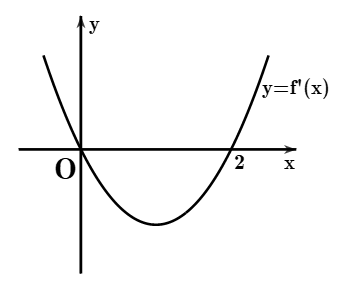 Số điểm cực tiểu của hàm số $g\left( x \right)=f\left( -{{x}^{2}}+x \right)$ là
A. $1$.
B. $4$.
C. $3$.
D. $2$.
A. $1$.
B. $4$.
C. $3$.
D. $2$.
Ta có $g\left( x \right)=f\left( -{{x}^{2}}+x \right)\Rightarrow {g}'\left( x \right)=\left( -2x+1 \right){f}'\left( -{{x}^{2}}+x \right)$.
$\Rightarrow {g}'\left( x \right)=0\Leftrightarrow \left( -2x+1 \right){f}'\left( -{{x}^{2}}+x \right)=0\Leftrightarrow \left[ \begin{aligned}
& -2x+1=0 \\
& {f}'\left( -{{x}^{2}}+x \right)=0 \\
\end{aligned} \right.\Leftrightarrow \left[ \begin{aligned}
& x=\dfrac{1}{2} \\
& -{{x}^{2}}+x=0 \\
& -{{x}^{2}}+x=2 \\
\end{aligned} \right.$$\Leftrightarrow \left[ \begin{aligned}
& x=\dfrac{1}{2} \\
& x=1 \\
& x=0 \\
\end{aligned} \right.$.
Do đó ${g}'\left( x \right)>0\Leftrightarrow \left( -2x+1 \right){f}'\left( -{{x}^{2}}+x \right)>0\Leftrightarrow \left[ \begin{aligned}
& \left\{ \begin{aligned}
& -2x+1>0 \\
& {f}'\left( -{{x}^{2}}+x \right)>0 \\
\end{aligned} \right. \\
& \left\{ \begin{aligned}
& -2x+1<0 \\
& {f}'\left( -{{x}^{2}}+x \right)<0 \\
\end{aligned} \right. \\
\end{aligned} \right.$
$\Leftrightarrow \left[ \begin{aligned}
& \left\{ \begin{aligned}
& x<\dfrac{1}{2} \\
& \left[ \begin{aligned}
& -{{x}^{2}}+x>2 \\
& -{{x}^{2}}+x<0 \\
\end{aligned} \right. \\
\end{aligned} \right. \\
& \left\{ \begin{aligned}
& x>\dfrac{1}{2} \\
& 0<-{{x}^{2}}+x<2 \\
\end{aligned} \right. \\
\end{aligned} \right.\Leftrightarrow \left[ \begin{aligned}
& \left\{ \begin{aligned}
& x<\dfrac{1}{2} \\
& \left[ \begin{aligned}
& x>1 \\
& x<0 \\
\end{aligned} \right. \\
\end{aligned} \right. \\
& \left\{ \begin{aligned}
& x>\dfrac{1}{2} \\
& 0<x<1 \\
\end{aligned} \right. \\
\end{aligned} \right.\Leftrightarrow \left[ \begin{aligned}
& x<0 \\
& \dfrac{1}{2}<x<1 \\
\end{aligned} \right.$.
Bảng biến thiên
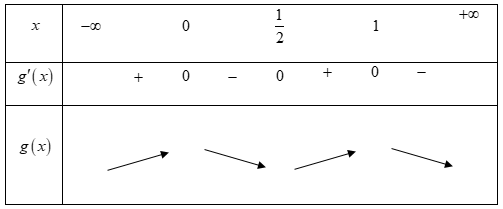 Vậy hàm số có 1 điểm cực tiểu.
$\Rightarrow {g}'\left( x \right)=0\Leftrightarrow \left( -2x+1 \right){f}'\left( -{{x}^{2}}+x \right)=0\Leftrightarrow \left[ \begin{aligned}
& -2x+1=0 \\
& {f}'\left( -{{x}^{2}}+x \right)=0 \\
\end{aligned} \right.\Leftrightarrow \left[ \begin{aligned}
& x=\dfrac{1}{2} \\
& -{{x}^{2}}+x=0 \\
& -{{x}^{2}}+x=2 \\
\end{aligned} \right.$$\Leftrightarrow \left[ \begin{aligned}
& x=\dfrac{1}{2} \\
& x=1 \\
& x=0 \\
\end{aligned} \right.$.
Do đó ${g}'\left( x \right)>0\Leftrightarrow \left( -2x+1 \right){f}'\left( -{{x}^{2}}+x \right)>0\Leftrightarrow \left[ \begin{aligned}
& \left\{ \begin{aligned}
& -2x+1>0 \\
& {f}'\left( -{{x}^{2}}+x \right)>0 \\
\end{aligned} \right. \\
& \left\{ \begin{aligned}
& -2x+1<0 \\
& {f}'\left( -{{x}^{2}}+x \right)<0 \\
\end{aligned} \right. \\
\end{aligned} \right.$
$\Leftrightarrow \left[ \begin{aligned}
& \left\{ \begin{aligned}
& x<\dfrac{1}{2} \\
& \left[ \begin{aligned}
& -{{x}^{2}}+x>2 \\
& -{{x}^{2}}+x<0 \\
\end{aligned} \right. \\
\end{aligned} \right. \\
& \left\{ \begin{aligned}
& x>\dfrac{1}{2} \\
& 0<-{{x}^{2}}+x<2 \\
\end{aligned} \right. \\
\end{aligned} \right.\Leftrightarrow \left[ \begin{aligned}
& \left\{ \begin{aligned}
& x<\dfrac{1}{2} \\
& \left[ \begin{aligned}
& x>1 \\
& x<0 \\
\end{aligned} \right. \\
\end{aligned} \right. \\
& \left\{ \begin{aligned}
& x>\dfrac{1}{2} \\
& 0<x<1 \\
\end{aligned} \right. \\
\end{aligned} \right.\Leftrightarrow \left[ \begin{aligned}
& x<0 \\
& \dfrac{1}{2}<x<1 \\
\end{aligned} \right.$.
Bảng biến thiên
Đáp án A.