
 Google
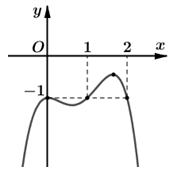
Câu hỏi: Cho hàm số ${y=f\left( x \right)}$ có đạo hàm trên ${\mathbb{R}}$ và đồ thị của hàm số ${f'\left( x \right)}$ như hình vẽ
Hàm số ${g\left( x \right)=f\left( x-1 \right)+x+5}$ đạt cực tiểu tại điểm
A. ${x=- 1.}$
B. ${x=2.}$
C. ${x=1.}$
D. ${x=3.}$
Hàm số ${g\left( x \right)=f\left( x-1 \right)+x+5}$ đạt cực tiểu tại điểm
A. ${x=- 1.}$
B. ${x=2.}$
C. ${x=1.}$
D. ${x=3.}$
Ta có : $g\left( x \right)=f'\left( x-1 \right)+1.$
Dựa vào đồ thị của hàm số $f'\left( x \right)$ như hình vẽ ta có:
$g'\left( x \right)=0\Leftrightarrow f'\left( x-1 \right)+1=0\Leftrightarrow f'\left( x-1 \right)=-1\Leftrightarrow \left[ \begin{aligned}
& x-1=0 \\
& x-1=1 \\
& x-1=2 \\
\end{aligned} \right.\Leftrightarrow \left[ \begin{aligned}
& x=1\left( nghiemboichan \right) \\
& x=2\left( nghiemboile \right) \\
& x=3\left( nghiemboile \right) \\
\end{aligned} \right.$
Bảng biến thiên:

Dựa vào bảng biến thiên ta thấy hàm số đạt cực tiểu tại điểm $x=2$
Dựa vào đồ thị của hàm số $f'\left( x \right)$ như hình vẽ ta có:
$g'\left( x \right)=0\Leftrightarrow f'\left( x-1 \right)+1=0\Leftrightarrow f'\left( x-1 \right)=-1\Leftrightarrow \left[ \begin{aligned}
& x-1=0 \\
& x-1=1 \\
& x-1=2 \\
\end{aligned} \right.\Leftrightarrow \left[ \begin{aligned}
& x=1\left( nghiemboichan \right) \\
& x=2\left( nghiemboile \right) \\
& x=3\left( nghiemboile \right) \\
\end{aligned} \right.$
Bảng biến thiên:
Dựa vào bảng biến thiên ta thấy hàm số đạt cực tiểu tại điểm $x=2$
Đáp án B.