
 Google
Câu hỏi: Cho hàm số bậc ba y = f ( x ). Biết hàm số có điểm cực đại là x = 3 và điểm cực tiểu là x = 6. Hỏi hàm số $y=g\left( x \right)=f\left( {{x}^{2}}-2x+4 \right)$ nghịch biến trên khoảng nào dưới đây?
A. $\left( 1;2 \right)$
B. $\left( 2;3 \right)$
C. $\left( 0;1 \right)$
D. $\left( 3;4 \right)$
A. $\left( 1;2 \right)$
B. $\left( 2;3 \right)$
C. $\left( 0;1 \right)$
D. $\left( 3;4 \right)$
Phương pháp:
Hàm số $y=f\left( x \right)$ nghịch biến trên $\left( a;b \right)\Leftrightarrow f'\left( x \right)\le 0\forall x\in \left( a;b \right)$
Vẽ BBT của hàm số $y=f\left( x \right)$ sau đó dựa vào BBT để nhận xét khoảng nghịch biến của hàm số $y=g\left( x \right)=f\left( {{x}^{2}}-2x+4 \right)$
Cách giải:
Theo đề bài ta có: Hàm số $y=f\left( x \right)$ có điểm cực đại là $x=3$ và điểm cực tiểu là $x=6$ nên ta có BBT:
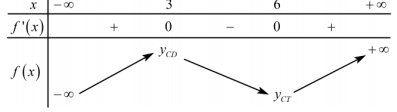
Dựa vào BBT ta thấy hàm số $y=f\left( x \right)$ nghịch biến trên $\left( 3;6 \right)$
Ta có: $g'\left( x \right)=\left[ f\left( {{x}^{2}}-2x+4 \right) \right]'=\left( 2x-2 \right)f'\left( {{x}^{2}}-2x+4 \right)$
⇒ Hàm số $y=g\left( x \right)=f\left( {{x}^{2}}-2x+4 \right)$ nghịch biến $\Leftrightarrow g'\left( x \right)\le 0$
$\Leftrightarrow \left( 2x-2 \right)f'\left( {{x}^{2}}-2x+4 \right)\le 0$
$\Leftrightarrow \left[ \begin{aligned}
& \left\{ \begin{aligned}
& 2x-2\le 0 \\
& f'\left( {{x}^{2}}-2x+4 \right)\ge 0 \\
\end{aligned} \right. \\
& \left\{ \begin{aligned}
& 2x-2\ge 0 \\
& f'\left( {{x}^{2}}-2x+4 \right)\le 0 \\
\end{aligned} \right. \\
\end{aligned} \right. $ $ \Leftrightarrow \left[ \begin{aligned}
& x\le 1 \\
& \left[ \begin{aligned}
& {{x}^{2}}-2x+4\le 3 \\
& {{x}^{2}}-2x+4\ge 6 \\
\end{aligned} \right. \\
& \left\{ \begin{aligned}
& x\ge 1 \\
& {{x}^{2}}-2x+4\ge 3 \\
& {{x}^{2}}-2x+4\le 6 \\
\end{aligned} \right. \\
\end{aligned} \right.$
$\Leftrightarrow \left[ \begin{aligned}
& \left\{ \begin{aligned}
& x\le 1 \\
& \left[ \begin{aligned}
& {{x}^{2}}-2x+1\ge 0 \\
& {{x}^{2}}-2x-2\ge 0 \\
\end{aligned} \right. \\
\end{aligned} \right. \\
& \left\{ \begin{aligned}
& x\ge 1 \\
& {{x}^{2}}-2x+1\ge 0 \\
& {{x}^{2}}-2x-2\le 0 \\
\end{aligned} \right. \\
\end{aligned} \right. $ $ \Leftrightarrow \left[ \begin{aligned}
& x\le 1 \\
& \left[ \begin{aligned}
& x=1 \\
& x\ge 1+\sqrt{3} \\
& x\le 1-\sqrt{3} \\
\end{aligned} \right. \\
& \left\{ \begin{aligned}
& x\ge 1 \\
& \forall x\in \mathbb{R} \\
& 1-\sqrt{3}\le x\le 1+\sqrt{3} \\
\end{aligned} \right. \\
\end{aligned} \right.\Leftrightarrow \left[ \begin{aligned}
& x\le 1-\sqrt{3} \\
& 1\le x\le 1+\sqrt{3} \\
\end{aligned} \right.$
Vậy hàm số $y=g\left( x \right)$ nghịch biến trên $\begin{array}{*{35}{l}}
\left( -\infty ;1-\sqrt{3} \right)v\grave{a}\left[ 1;1+\sqrt{3} \right]~ \\
~ \\
\end{array}$
Hàm số $y=f\left( x \right)$ nghịch biến trên $\left( a;b \right)\Leftrightarrow f'\left( x \right)\le 0\forall x\in \left( a;b \right)$
Vẽ BBT của hàm số $y=f\left( x \right)$ sau đó dựa vào BBT để nhận xét khoảng nghịch biến của hàm số $y=g\left( x \right)=f\left( {{x}^{2}}-2x+4 \right)$
Cách giải:
Theo đề bài ta có: Hàm số $y=f\left( x \right)$ có điểm cực đại là $x=3$ và điểm cực tiểu là $x=6$ nên ta có BBT:
Dựa vào BBT ta thấy hàm số $y=f\left( x \right)$ nghịch biến trên $\left( 3;6 \right)$
Ta có: $g'\left( x \right)=\left[ f\left( {{x}^{2}}-2x+4 \right) \right]'=\left( 2x-2 \right)f'\left( {{x}^{2}}-2x+4 \right)$
⇒ Hàm số $y=g\left( x \right)=f\left( {{x}^{2}}-2x+4 \right)$ nghịch biến $\Leftrightarrow g'\left( x \right)\le 0$
$\Leftrightarrow \left( 2x-2 \right)f'\left( {{x}^{2}}-2x+4 \right)\le 0$
$\Leftrightarrow \left[ \begin{aligned}
& \left\{ \begin{aligned}
& 2x-2\le 0 \\
& f'\left( {{x}^{2}}-2x+4 \right)\ge 0 \\
\end{aligned} \right. \\
& \left\{ \begin{aligned}
& 2x-2\ge 0 \\
& f'\left( {{x}^{2}}-2x+4 \right)\le 0 \\
\end{aligned} \right. \\
\end{aligned} \right. $ $ \Leftrightarrow \left[ \begin{aligned}
& x\le 1 \\
& \left[ \begin{aligned}
& {{x}^{2}}-2x+4\le 3 \\
& {{x}^{2}}-2x+4\ge 6 \\
\end{aligned} \right. \\
& \left\{ \begin{aligned}
& x\ge 1 \\
& {{x}^{2}}-2x+4\ge 3 \\
& {{x}^{2}}-2x+4\le 6 \\
\end{aligned} \right. \\
\end{aligned} \right.$
$\Leftrightarrow \left[ \begin{aligned}
& \left\{ \begin{aligned}
& x\le 1 \\
& \left[ \begin{aligned}
& {{x}^{2}}-2x+1\ge 0 \\
& {{x}^{2}}-2x-2\ge 0 \\
\end{aligned} \right. \\
\end{aligned} \right. \\
& \left\{ \begin{aligned}
& x\ge 1 \\
& {{x}^{2}}-2x+1\ge 0 \\
& {{x}^{2}}-2x-2\le 0 \\
\end{aligned} \right. \\
\end{aligned} \right. $ $ \Leftrightarrow \left[ \begin{aligned}
& x\le 1 \\
& \left[ \begin{aligned}
& x=1 \\
& x\ge 1+\sqrt{3} \\
& x\le 1-\sqrt{3} \\
\end{aligned} \right. \\
& \left\{ \begin{aligned}
& x\ge 1 \\
& \forall x\in \mathbb{R} \\
& 1-\sqrt{3}\le x\le 1+\sqrt{3} \\
\end{aligned} \right. \\
\end{aligned} \right.\Leftrightarrow \left[ \begin{aligned}
& x\le 1-\sqrt{3} \\
& 1\le x\le 1+\sqrt{3} \\
\end{aligned} \right.$
Vậy hàm số $y=g\left( x \right)$ nghịch biến trên $\begin{array}{*{35}{l}}
\left( -\infty ;1-\sqrt{3} \right)v\grave{a}\left[ 1;1+\sqrt{3} \right]~ \\
~ \\
\end{array}$
Đáp án A.